Introduction
Chronic kidney disease (CKD) is a major public
health concern worldwide because of the increasing prevalence of
end-stage renal failure requiring dialysis or kidney
transplantation and the increased risk of morbidity and mortality
due to cardiovascular diseases (1–6). Aging
leads to renal structural changes and functional decline. Imai
et al(7) and Coresh et
al(8) suggested that the
prevalence of CKD increases with age. Moreover, a significantly
higher prevalence of CKD was reported in hypertensive patients
compared to normotensive subjects (8,9). High
systemic blood pressure leads to pressure elevation in the
glomerular capillaries, which is associated with renal vascular
dysfunction. Elevated pressure in the glomerular capillaries
results in glomerular sclerosis, increased albuminuria and
decreased glomerular filtration rate (10). Furthermore, glomerular
hyperfiltration is often observed during the early stages of
diabetes and may contribute to the development of diabetic
nephropathy (11,12). Thus, the progression of CKD is
affected by various risk factors such as aging, hypertension and
hyperfiltration. However, the interrelationship of individual risk
factors during the course of renal dysfunction has not been fully
elucidated.
Tsukuba hypertensive mice (THM) are transgenic mice
carrying both human renin and angiotensinogen genes. These animals
are prone to developing hypertension (13–15).
Kai et al(16,17) observed albuminuria and glomerular
sclerosis in 28-week-old THM. Thus, the THM is a useful model of
hypertensive nephropathy induced by overproduction of angiotensin
II.
In the present study, the effects of aging and
uninephrectomy (UNx)-induced hyperfiltration on renal dysfunction
were investigated in THM, as was the interrelationship of risk
factors during the development of renal disease under hyper-tensive
conditions.
Materials and methods
Animals
Male THM were purchased from RIKEN BioResource
Center (Ibaraki, Japan) with the support of the National
Bio-Resource Project of the Ministry of Education, Culture, Sports,
Science and Technology of Japan. Age-matched male C57BL/6J mice,
used as genetic background-matched wild-type mice (WTM), were
purchased from Clea Japan Co., Ltd. (Tokyo, Japan). The mice were
housed in a room maintained at 22±2°C with 55±5% relative humidity,
exposed to a 12:12-h light-dark cycle and allowed free access to
food and water. The animal experiments were performed in accordance
with the ethical guidelines established by the Experimental Animal
Care and Use Committee of Mitsubishi Tanabe Pharma Corporation.
UNx
THM and WTM, 22–26 weeks of age, were subjected to
UNx or sham operation under sevoflurane (Maruishi Pharmaceutical
Co. Ltd., Osaka, Japan) anesthesia. For UNx, the abdomen was opened
through a left paramedian incision and the left kidney was exposed.
The renal vessels and ureter were carefully isolated, ligated with
a silk thread and the distal portions were cut. Control animals
underwent sham operation. The mice were sacrificed at 6 weeks after
surgery.
Sample collection
Prior to sacrifice, 24-, 36-, 48- and 60-week-old
male THM and WTM, uninephrectomized THM (UNx-THM) and WTM (UNx-WTM)
and sham-operated THM (sham-THM) and WTM (sham-WTM), were placed
individually in metabolic cages (Shinano Manufacturing Co., Ltd.,
Tokyo, Japan) for 24-h urine collection. Urine samples were
centrifuged at 1,000 × g for 10 min at 20°C and the supernatants
were stored at −20°C until analysis. The mice were anesthetized
with sevoflurane and sacrificed by whole blood collection from the
abdominal aorta. Blood samples were centrifuged at 3,000 × g for 5
min at 4°C and the plasma was separated and stored at −80°C until
analysis. Immediately after the animals were sacrificed, the whole
kidneys of 24-, 36-, 48- and 60-week-old THM and WTM were isolated
and stored in RNAlater® solution (Life Technologies,
Inc., Gaithersburg, MD, USA) at −80°C until RNA extraction and
analysis. In the UNx experiment, approximately half of the right
kidneys were isolated and stored in RNAlater solution, then stored
at −80°C until analysis. Part of the remaining halves of the right
kidneys were fixed with 2.5% glutaraldehyde in phosphate buffer,
post-fixed in 1% osmium tetroxide and embedded in epoxy resin
blocks for examination under an electron microscope. The remaining
parts of the right kidneys were fixed with 10% formalin and
embedded in paraffin blocks for staining with periodic
acid-Schiff's base.
Measurement of markers of renal
function
Urinary albumin (Alb) and neutrophil
gelatinase-associated lipocalin (NGAL) concentrations were
determined by the Mouse Albumin ELISA kit (Shibayagi Co., Ltd.,
Gunma, Japan) and Mouse Lipocalin-2/NGAL Quantikine ELISA kit
(R&D Systems Inc., Minneapolis, MN, USA), respectively. Urinary
and plasma creatinine (Cr) concentrations were measured by Jaffe's
method using the Creatinine-Test-Wako (Wako Pure Chemical
Industries, Ltd., Osaka, Japan). Alb and NGAL excretion were
expressed as the Alb/Cr and NGAL/Cr ratios, respectively.
Measurement of mRNA expression
Total RNA was isolated from the kidneys using
TRIzol® reagent (Life Technologies, Inc.). Reverse
transcription to cDNA of 1 μg of total RNA from each sample
was performed using the High Capacity RNA-to-cDNA kit (Life
Technologies, Inc.). Real-time polymerase chain reaction (PCR) was
performed on a 7500 Fast Real-Time PCR system (Life Technologies,
Inc.), using specific TaqMan Gene Expression assays for monocyte
chemoattractant protein-1 (MCP-1) (Mm00441242_m1) and renal
collagen type I α 2 (COL1A2) (Mm00483888_m1) (Life Technologies,
Inc.), according to the manufacturer's instructions. Expression
levels of target genes were normalized to the levels of 18S rRNA
which was measured with the TaqMan® Ribosomal RNA
Control Reagents kit (Life Technologies, Inc.).
Histology and electron microscopy
The glomerular sclerosis index (GSI) was calculated
according to the method previously described by Simokama et
al(18). Glomerular lesions
were graded from 0 to 4+ on the basis of the extent of glomerular
damage and evidence of tuft involvement, as follows: 0, no evidence
of lesions; 1+, ≤25% of tufts affected by sclerosis; 2+, tuft
involvement of 25–50%; 3+, tuft involvement of 50–75%; 4+, almost
complete tuft involvement. For each kidney, the sum of the results
for 20 glomeruli was defined as the GSI. The structural integrity
of the glomerular filtration barrier was confirmed by examination
under an electron microscope. Semi-thin sections from each epoxy
resin block, stained with toluidine blue, were used to select areas
for electron microscopic examination. Ultra-thin sections were
stained with uranyl acetate and lead citrate and examined under an
H-7500 electron microscope (Hitachi, Ltd., Tokyo, Japan).
Statistical analysis
Values were presented as the mean ± standard error
of the mean (SEM), unless otherwise stated. The results were
analyzed using GraphPad Prism version 5.02 (GraphPad Software,
Inc., San Diego, CA, USA). Linear regression analysis was performed
to calculate the slope of the age-related changes in THM and WTM.
Analysis of variance was used to compare the slopes between THM and
WTM. The significance of differences between UNx- and sham-THM, or
UNx- and sham-WTM, was evaluated using the Student's t-test.
Probabilities <5% (P<0.05) were considered to indicate a
statistically significant difference.
Results
Effects of aging on glomerular and
tubular injury in THM
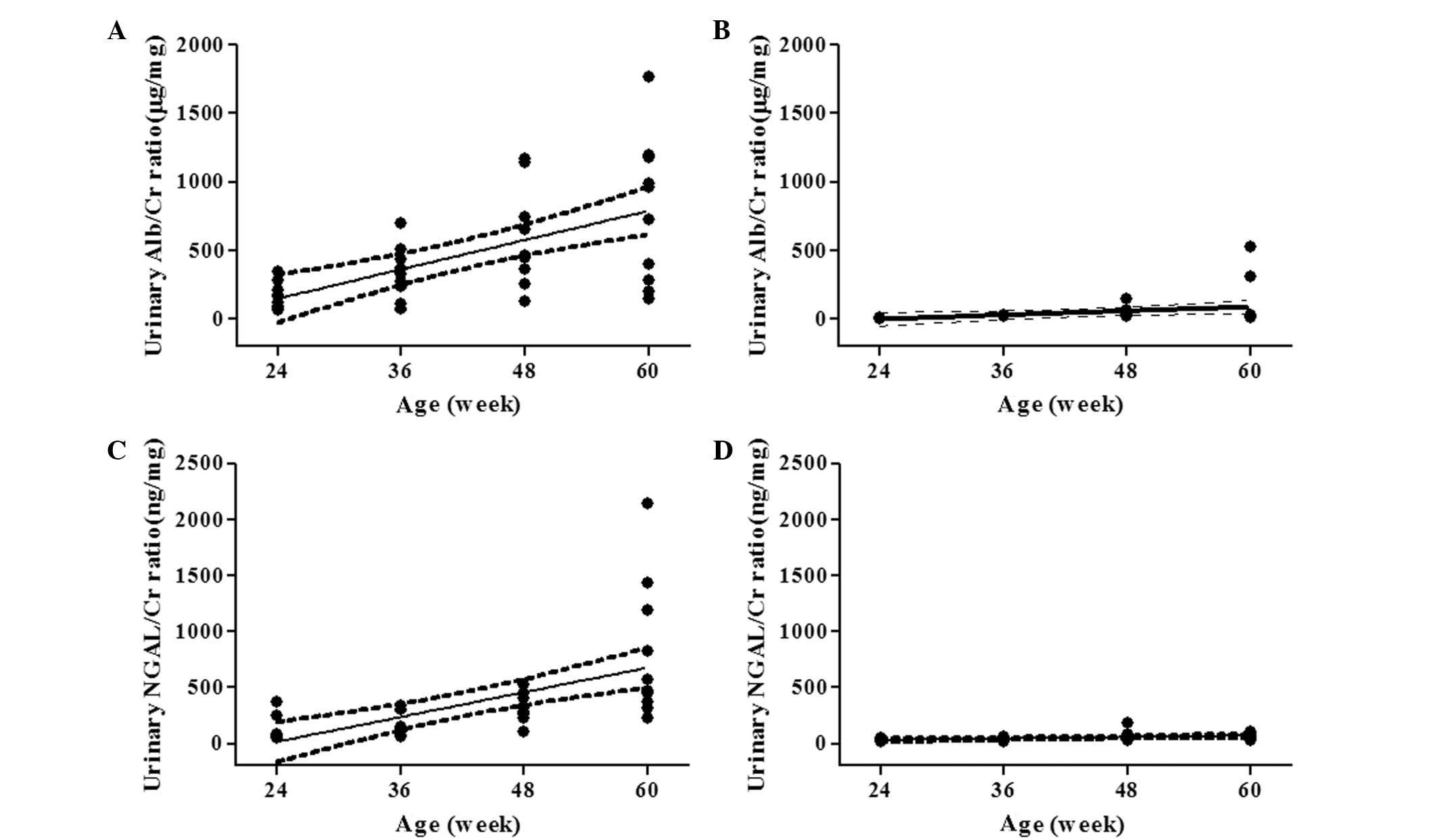
The urinary Alb/Cr and NGAL/Cr ratios in 60-week-old
THM were higher than those in 60-week-old WTM (785.5±167.1 vs.
97.5±55.5 μg/mg and 802.2±194.6 vs. 65.8±9.2 mg/mg,
respectively). THM and WTM exhibited a linear increase in the
urinary Alb/Cr ratio with age, with a slope [95% confidence
interval (CI)] of 17.8 (10.1–25.6) (r2=0.363, P<0.01)
and 2.45 (0.267–4.63) (r2=0.123, P<0.05),
respectively. The slope of THM was significantly steeper than that
of WTM (Fig. 1A and B). In
addition, a linear increase in the urinary NGAL/Cr ratio with age
was also demonstrated by a slope (95% CI) of 18.4 (10.4–26.4)
(r2=0.365, P<0.01) for THM and 1.11 (0.395–1.82)
(r2=0.212, P<0.01) for WTM. The age-related increase
in the urinary NGAL/Cr ratio was more pronounced in THM (Fig. 1C and D). As shown in Fig. 2A and B, a more marked increase in
renal MCP-1 mRNA expression with age was observed in THM, compared
to that in WTM. Renal COL1A2 mRNA expression increased with age in
THM, but not in WTM (Fig. 2C and
D). Plasma Cr concentration, a marker of glomerular
dysfunction, was not affected by age in THM or WTM (Fig. 3A and B).
Effects of UNx on glomerular and tubular
injury in THM
The urinary Alb/Cr ratio in UNx-THM was
significantly higher than that in sham-THM (Fig. 4A). By contrast, the urinary NGAL/Cr
ratio was unaffected by UNx in THM (Fig. 4B). In WTM, the urinary Alb/Cr ratio
was slightly decreased following UNx (Fig. 4A). The urinary NGAL/Cr ratio was
unaffected by UNx (Fig. 4B).
Expression of renal MCP-1 and COL1A2 mRNA was similar between UNx
and sham animals in both THM and WTM (Fig. 5A and B).
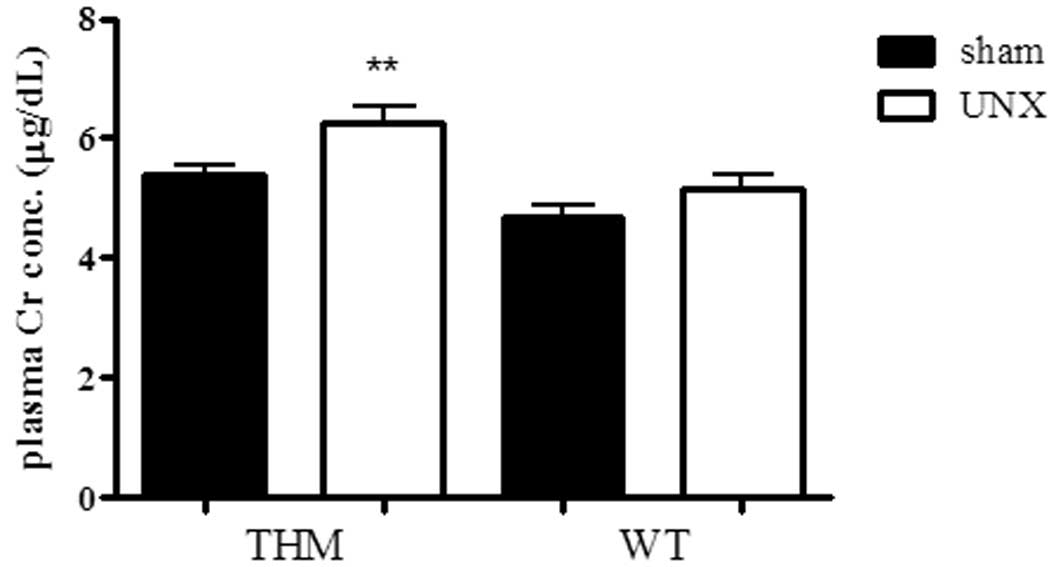
The plasma Cr concentration was significantly
increased in UNx-THM, but not in UNx-WTM (Fig. 6). However, GSI did not increase
following UNx in THM (Fig. 7A) and
there were no significant differences in the structure of the
podocytes and foot processes, slit diaphragms or glomerular
basement membrane (GBM) thickness between UNx-THM and sham-THM
(Fig. 7B).
Discussion
As mentioned above, various risk factors, such as
hypertension, aging and hyperfiltration, affect the progression of
CKD (1,11,19,20).
In the present study, the interrelationship of these risk factors
was investigated. The results indicated that aging and UNx exerted
a similar effect on the development of albuminuria in THM. Of note,
although the urinary NGAL/Cr ratio and renal MCP-1 and COL1A2 mRNA
expression were increased with age in THM, these alterations were
not observed in UNx-THM. Plasma Cr concentration was elevated by
UNx only in THM. These results demonstrated that age- and
UNx-related renal changes differed on a qualitative level.
Albuminuria may result from changes in glomerular
filtration, as well as from reduced reabsorption of filtered
albumin by the proximal tubule (21,22).
Therefore, the effect of aging on the urinary NGAL/Cr ratio was
investigated. In THM, the urinary NGAL/Cr ratio increased with age.
There was no effect of aging on plasma NGAL levels in THM (data not
shown) and the reabsorption of NGAL by the tubular epithelial cells
after glomerular filtration has been well-characterized (23). Thus, the present study has
demonstrated that urinary NGAL may be considered as a biomarker of
tubular damage. These observations suggest that the development of
albuminuria in THM was accelerated by aging and that age-related
renal changes were induced by renal tubular damage.
In the kidney, MCP-1 plays an important role in
recruiting monocytes/macrophages to the injured tubulointerstitial
tissue (24). Furthermore, COL1A2
is associated with tubulointerstitial fibrosis (25). In this study, the levels of renal
MCP-1 and COL1A2 mRNA expression increased with age in THM. Renal
tubular inflammation and tubulointerstitial fibrosis contributed to
the progression of renal tubular damage and renal dysfunction
(26,27). Thus, the results of this study have
demonstrated that the age-related albuminuria observed in THM was
caused by renal tubular damage.
Shimokama et al(18) reported moderate focal segmental
glomerular sclerosis in THM. However, this study did not
demonstrate an increase in plasma Cr concentration with age in THM.
In addition, aging exerted no effects on the glomerular filtration
barrier (data not shown). Taken together, these observations
strongly suggest that age-related albuminuria in THM was mainly
caused by renal tubular damage rather than glomerular
dysfunction.
UNx induces glomerular hyperfiltration and is
associated with albuminuria in experimental animal models (28). An increased urinary Alb/Cr ratio was
observed following UNx in THM in the present study. However, the
urinary NGAL/Cr ratio and renal MCP-1 and COL1A2 mRNA levels were
unaffected by UNx, indicating that UNx-related renal changes
differed from those induced by aging. Moreover, these results
demonstrated that UNx-induced albuminuria was not caused by renal
tubular injury.
In the present study, the plasma Cr concentration
was increased following UNx in THM, suggesting that glomerular
dysfunction developed in UNx-THM. The glomerular filtration barrier
is formed by three layers: the innermost fenestrated vascular
endothelium, the GBM and the podocyte layer (29). Glomerular size selectivity is
maintained by the GBM and the slit pore diaphragm between the foot
processes of podocytes (29).
However, no progression of glomerular sclerosis, loss of slit
diaphragms or increased GBM thickness was observed when comparing
UNx-THM to sham-THM. Therefore, UNx exerted no effect on the
integrity of the glomerular filtration barrier and the UNx-induced
albuminuria in THM may not be attributed to changes in glomerular
size selectivity.
Charge selectivity is attributed to the anionic
sites of the glomerular endothelial surface layer (ESL) (30). Loss of the glomerular ESL has been
associated with albuminuria in patients with diabetic nephropathy
and in an experimental animal model (31,32).
In the present study, the loss of anionic charges in the GBM and
ESL was not assessed in UNx-THM. Therefore, further investigations
are required to elucidate the involvement of a charge-selective
glomerular filtration barrier in renal dysfunction of UNx-THM.
In conclusion, this study has demonstrated that
aging and hyperfiltration accelerated the development of
albuminuria in hypertensive mice and that these renal changes
differed in origin. Age-related albuminuria was mainly caused by
renal tubular damage and UNx-induced albuminuria was due to
glomerular dysfunction. These findings indicate that the
pathophysiology of CKD is complicated. A diversity of therapeutic
approaches must be applied to the treatment of renal dysfunction to
address the possible implicated factors.
Acknowledgements
The authors would like to thank Dr M.
Nagasaki, Dr A. Umeda, Dr R. Yamauchi, Dr H. Doi, Dr K. Kikkawa, Dr
M. Nishio, Mr. Y. Egi, Mr. K. Fujitaka, Ms. Y. Ogawa, Mr. K. Fujiki
and Ms. A. Yamazaki of Mitsubishi Tanabe Pharma Corporation for
their support and for their help with the statistical analysis.
References
|
1
|
Levey AS, Eckardt KU, Tsukamoto Y, et al:
Definition and classification of chronic kidney disease: a position
statement from Kidney Disease: Improving Global Outcomes (KDIGO).
Kidney Int. 67:2089–2100. 2005. View Article : Google Scholar : PubMed/NCBI
|
|
2
|
Jungers P: Screening for renal
insufficiency: is it worth while? is it feasible? Nephrol Dial
Transplant. 14:2082–2084. 1999. View Article : Google Scholar : PubMed/NCBI
|
|
3
|
Akiba T, Nakai S, Shinzato T, et al: Why
has the gross mortality of dialysis patients increased in Japan?
Kidney Int. 57:S60–S65. 2000. View Article : Google Scholar
|
|
4
|
Weiner DE, Tighiouart H, Amin MG, et al:
Chronic kidney disease as a risk factor for cardiovascular disease
and all-cause mortality: a pooled analysis of community-based
studies. J Am Soc Nephrol. 15:1307–1315. 2004. View Article : Google Scholar : PubMed/NCBI
|
|
5
|
Jafar TH, Stark PC, Schmid CH, et al:
Progression of chronic kidney disease: the role of blood pressure
control, proteinuria, and angiotensin-converting enzyme inhibition:
a patient-level meta-analysis. Ann Intern Med. 139:244–252. 2003.
View Article : Google Scholar : PubMed/NCBI
|
|
6
|
Iseki K, Ikemiya Y, Iseki C and Takishita
S: Proteinuria and the risk of developing end-stage renal disease.
Kidney Int. 63:1468–1474. 2003. View Article : Google Scholar : PubMed/NCBI
|
|
7
|
Imai E, Horio M, Iseki K, et al:
Prevalence of chronic kidney disease (CKD) in the Japanese general
population predicted by the MDRD equation modified by a Japanese
coefficient. Clin Exp Nephrol. 11:156–163. 2007. View Article : Google Scholar : PubMed/NCBI
|
|
8
|
Coresh J, Astor BC, Greene T, Eknoyan G
and Levey AS: Prevalence of chronic kidney disease and decreased
kidney function in the adult US population: Third National Health
and Nutrition Examination Survey. Am J Kidn Dis. 41:1–12. 2003.
View Article : Google Scholar : PubMed/NCBI
|
|
9
|
Tozawa M, Iseki K, Iseki C, Kinjo K,
Ikemiya Y and Takishita S: Blood pressure predicts risk of
developing end-stage renal disease in men and women. Hypertension.
41:1341–1345. 2003. View Article : Google Scholar : PubMed/NCBI
|
|
10
|
Feld LG, Van Liew JB, Galaske RG and
Boylan JW: Selectivity of renal injury and proteinuria in the
spontaneously hypertensive rat. Kidney Int. 12:332–343. 1977.
View Article : Google Scholar : PubMed/NCBI
|
|
11
|
Levine DZ: Can rodent models of diabetic
kidney disease clarify the significance of early hyperfiltration?:
recognizing clinical and experimental uncertainties. Clin Sci
(Lond). 114:109–118. 2008. View Article : Google Scholar
|
|
12
|
Yamagata K, Ishida K, Sairenchi T, et al:
Risk factors for chronic kidney disease in a community-based
population: a 10-year follow-up study. Kidney Int. 71:159–166.
2007.PubMed/NCBI
|
|
13
|
Fukamizu A, Sugimura K, Takimoto E, et al:
Chimeric renin-angiotensin system demonstrates sustained increase
in blood pressure of transgenic mice carrying both human renin and
human angiotensinogen genes. J Biol Chem. 268:11617–11621.
1993.
|
|
14
|
Fukamizu A, Seo MS, Hatae T, et al:
Tissue-specific expression of the human renin gene in transgenic
mice. Biochem Biophys Res Commun. 165:826–832. 1989. View Article : Google Scholar : PubMed/NCBI
|
|
15
|
Takahashi S, Fukamizu A, Hasegawa T, et
al: Expression of the human angiotensinogen gene in transgenic mice
and transfected cells. Biochem Biophys Res Commun. 180:1103–1109.
1991. View Article : Google Scholar : PubMed/NCBI
|
|
16
|
Kai T, Sugimura K, Shimada S, Kurooka A,
Takenaka T and Ishikawa K: Inhibitory effects of a subdepressor
dose of L-158,809, an angiotensin II type 1 receptor antagonist, on
cardiac hypertrophy and nephropathy via the activated human
renin-angiotensin system in double transgenic mice with
hyper-tension. Jpn Circ J. 62:599–603. 1998. View Article : Google Scholar
|
|
17
|
Kai T, Kino H and Ishikawa K: Role of the
renin-angiotensin system in cardiac hypertrophy and renal
glomerular sclerosis in transgenic hypertensive mice carrying both
human renin and angiotensinogen genes. Hypertens Res. 21:39–46.
1998. View Article : Google Scholar
|
|
18
|
Shimokama T, Haraoka S, Horiguchi H,
Sugiyama F, Murakami K and Watanabe T: The Tsukuba hypertensive
mouse (transgenic mouse carrying human genes for both renin and
angiotensinogen) as a model of human malignant hypertension:
development of lesions and morphometric analysis. Virchows Archiv.
432:169–175. 1998. View Article : Google Scholar
|
|
19
|
Hsu CY, Iribarren C, McCulloch CE,
Darbinian J and Go AS: Risk factors for end-stage renal disease:
25-year follow-up. Arch Inter Med. 169:342–350. 2009.PubMed/NCBI
|
|
20
|
Helal I, Fick-Brosnahan GM, Reed-Gitomer B
and Schrier RW: Glomerular hyperfiltration: definitions, mechanisms
and clinical implications. Nat Rev Nephrol. 8:293–300. 2012.
View Article : Google Scholar : PubMed/NCBI
|
|
21
|
Russo LM, Sandoval RM, Campos SB,
Molitoris BA, Comper WD and Brown D: Impaired tubular uptake
explains albuminuria in early diabetic nephropathy. J Am Soc
Nephrol. 20:489–494. 2009. View Article : Google Scholar : PubMed/NCBI
|
|
22
|
Comper WD, Haraldsson B and Deen WM:
Resolved: normal glomeruli filter nephrotic levels of albumin. J Am
Soc Nephrol. 19:427–432. 2008. View Article : Google Scholar : PubMed/NCBI
|
|
23
|
Birn H and Christensen EI: Renal albumin
absorption in physiology and pathology. Kidney Int. 69:440–449.
2006. View Article : Google Scholar : PubMed/NCBI
|
|
24
|
Wada T, Furuichi K, Sakai N, et al:
Up-regulation of monocyte chemoattractant protein-1 in
tubulointerstitial lesions of human diabetic nephropathy. Kidney
Int. 58:1492–1499. 2000. View Article : Google Scholar : PubMed/NCBI
|
|
25
|
Korrapati MC, Shaner BE, Neely BA, Alge
JL, Arthur JM and Schnellmann RG: Diabetes-induced renal injury in
rats is attenuated by suramin. J Pharmacol Exp Ther. 343:34–43.
2012. View Article : Google Scholar : PubMed/NCBI
|
|
26
|
Eardley KS, Zehnder D, Quinkler M, et al:
The relationship between albuminuria, MCP-1//CCL2, and interstitial
macrophages in chronic kidney disease. Kidney Int. 69:1189–1197.
2006. View Article : Google Scholar : PubMed/NCBI
|
|
27
|
Taniguchi H, Kojima R, Sade H, Furuya M,
Inomata N and Ito M: Involvement of MCP-1 in tubulointerstitial
fibrosis through massive proteinuria in anti-GBM nephritis induced
in WKY rats. J Clin Immunol. 27:409–429. 2007. View Article : Google Scholar : PubMed/NCBI
|
|
28
|
Hostetter TH, Olson JL, Rennke HG,
Venkatachalam MA and Brenner BM: Hyperfiltration in remnant
nephrons: a potentially adverse response to renal ablation. Am J
Physiol. 241:F85–F93. 1981.PubMed/NCBI
|
|
29
|
Kanwar YS, Danesh FR and Chugh SS:
Contribution of proteoglycans towards the integrated functions of
renal glomerular capillaries: a historical perspective. Am J
Pathol. 171:9–13. 2007. View Article : Google Scholar : PubMed/NCBI
|
|
30
|
Haraldsson B, Nyström J and Deen WM:
Properties of the glomerular barrier and mechanisms of proteinuria.
Physiol Rev. 88:451–487. 2008. View Article : Google Scholar : PubMed/NCBI
|
|
31
|
Broekhuizen LN, Lemkes BA, Mooij HL, et
al: Effect of sulodexide on endothelial glycocalyx and vascular
permeability in patients with type 2 diabetes mellitus.
Diabetologia. 53:2646–2655. 2010. View Article : Google Scholar : PubMed/NCBI
|
|
32
|
Salmon AHJ, Ferguson JK, Burford JL, et
al: Loss of the endothelial glycocalyx links albuminuria and
vascular dysfunction. J Am Soc Nephrol. 23:1339–1350. 2012.
View Article : Google Scholar : PubMed/NCBI
|