Spandidos Publications Logo
  • About
    • About Spandidos
    • Aims and Scopes
    • Abstracting and Indexing
    • Editorial Policies
    • Reprints and Permissions
    • Job Opportunities
    • Terms and Conditions
    • Contact
  • Journals
    • All Journals
    • Oncology Letters
      • Oncology Letters
      • Information for Authors
      • Editorial Policies
      • Editorial Board
      • Aims and Scope
      • Abstracting and Indexing
      • Bibliographic Information
      • Archive
    • International Journal of Oncology
      • International Journal of Oncology
      • Information for Authors
      • Editorial Policies
      • Editorial Board
      • Aims and Scope
      • Abstracting and Indexing
      • Bibliographic Information
      • Archive
    • Molecular and Clinical Oncology
      • Molecular and Clinical Oncology
      • Information for Authors
      • Editorial Policies
      • Editorial Board
      • Aims and Scope
      • Abstracting and Indexing
      • Bibliographic Information
      • Archive
    • Experimental and Therapeutic Medicine
      • Experimental and Therapeutic Medicine
      • Information for Authors
      • Editorial Policies
      • Editorial Board
      • Aims and Scope
      • Abstracting and Indexing
      • Bibliographic Information
      • Archive
    • International Journal of Molecular Medicine
      • International Journal of Molecular Medicine
      • Information for Authors
      • Editorial Policies
      • Editorial Board
      • Aims and Scope
      • Abstracting and Indexing
      • Bibliographic Information
      • Archive
    • Biomedical Reports
      • Biomedical Reports
      • Information for Authors
      • Editorial Policies
      • Editorial Board
      • Aims and Scope
      • Abstracting and Indexing
      • Bibliographic Information
      • Archive
    • Oncology Reports
      • Oncology Reports
      • Information for Authors
      • Editorial Policies
      • Editorial Board
      • Aims and Scope
      • Abstracting and Indexing
      • Bibliographic Information
      • Archive
    • Molecular Medicine Reports
      • Molecular Medicine Reports
      • Information for Authors
      • Editorial Policies
      • Editorial Board
      • Aims and Scope
      • Abstracting and Indexing
      • Bibliographic Information
      • Archive
    • World Academy of Sciences Journal
      • World Academy of Sciences Journal
      • Information for Authors
      • Editorial Policies
      • Editorial Board
      • Aims and Scope
      • Abstracting and Indexing
      • Bibliographic Information
      • Archive
    • International Journal of Functional Nutrition
      • International Journal of Functional Nutrition
      • Information for Authors
      • Editorial Policies
      • Editorial Board
      • Aims and Scope
      • Abstracting and Indexing
      • Bibliographic Information
      • Archive
    • International Journal of Epigenetics
      • International Journal of Epigenetics
      • Information for Authors
      • Editorial Policies
      • Editorial Board
      • Aims and Scope
      • Abstracting and Indexing
      • Bibliographic Information
      • Archive
    • Medicine International
      • Medicine International
      • Information for Authors
      • Editorial Policies
      • Editorial Board
      • Aims and Scope
      • Abstracting and Indexing
      • Bibliographic Information
      • Archive
  • Articles
  • Information
    • Information for Authors
    • Information for Reviewers
    • Information for Librarians
    • Information for Advertisers
    • Conferences
  • Language Editing
Spandidos Publications Logo
  • About
    • About Spandidos
    • Aims and Scopes
    • Abstracting and Indexing
    • Editorial Policies
    • Reprints and Permissions
    • Job Opportunities
    • Terms and Conditions
    • Contact
  • Journals
    • All Journals
    • Biomedical Reports
      • Information for Authors
      • Editorial Policies
      • Editorial Board
      • Aims and Scope
      • Abstracting and Indexing
      • Bibliographic Information
      • Archive
    • Experimental and Therapeutic Medicine
      • Information for Authors
      • Editorial Policies
      • Editorial Board
      • Aims and Scope
      • Abstracting and Indexing
      • Bibliographic Information
      • Archive
    • International Journal of Epigenetics
      • Information for Authors
      • Editorial Policies
      • Editorial Board
      • Aims and Scope
      • Abstracting and Indexing
      • Bibliographic Information
      • Archive
    • International Journal of Functional Nutrition
      • Information for Authors
      • Editorial Policies
      • Editorial Board
      • Aims and Scope
      • Abstracting and Indexing
      • Bibliographic Information
      • Archive
    • International Journal of Molecular Medicine
      • Information for Authors
      • Editorial Policies
      • Editorial Board
      • Aims and Scope
      • Abstracting and Indexing
      • Bibliographic Information
      • Archive
    • International Journal of Oncology
      • Information for Authors
      • Editorial Policies
      • Editorial Board
      • Aims and Scope
      • Abstracting and Indexing
      • Bibliographic Information
      • Archive
    • Medicine International
      • Information for Authors
      • Editorial Policies
      • Editorial Board
      • Aims and Scope
      • Abstracting and Indexing
      • Bibliographic Information
      • Archive
    • Molecular and Clinical Oncology
      • Information for Authors
      • Editorial Policies
      • Editorial Board
      • Aims and Scope
      • Abstracting and Indexing
      • Bibliographic Information
      • Archive
    • Molecular Medicine Reports
      • Information for Authors
      • Editorial Policies
      • Editorial Board
      • Aims and Scope
      • Abstracting and Indexing
      • Bibliographic Information
      • Archive
    • Oncology Letters
      • Information for Authors
      • Editorial Policies
      • Editorial Board
      • Aims and Scope
      • Abstracting and Indexing
      • Bibliographic Information
      • Archive
    • Oncology Reports
      • Information for Authors
      • Editorial Policies
      • Editorial Board
      • Aims and Scope
      • Abstracting and Indexing
      • Bibliographic Information
      • Archive
    • World Academy of Sciences Journal
      • Information for Authors
      • Editorial Policies
      • Editorial Board
      • Aims and Scope
      • Abstracting and Indexing
      • Bibliographic Information
      • Archive
  • Articles
  • Information
    • For Authors
    • For Reviewers
    • For Librarians
    • For Advertisers
    • Conferences
  • Language Editing
Login Register Submit
  • This site uses cookies
  • You can change your cookie settings at any time by following the instructions in our Cookie Policy. To find out more, you may read our Privacy Policy.

    I agree
Search articles by DOI, keyword, author or affiliation
Search
Advanced Search
presentation
Experimental and Therapeutic Medicine
Join Editorial Board Propose a Special Issue
Print ISSN: 1792-0981 Online ISSN: 1792-1015
Journal Cover
December 2013 Volume 6 Issue 6

Full Size Image

Sign up for eToc alerts
Recommend to Library

Journals

International Journal of Molecular Medicine

International Journal of Molecular Medicine

International Journal of Molecular Medicine is an international journal devoted to molecular mechanisms of human disease.

International Journal of Oncology

International Journal of Oncology

International Journal of Oncology is an international journal devoted to oncology research and cancer treatment.

Molecular Medicine Reports

Molecular Medicine Reports

Covers molecular medicine topics such as pharmacology, pathology, genetics, neuroscience, infectious diseases, molecular cardiology, and molecular surgery.

Oncology Reports

Oncology Reports

Oncology Reports is an international journal devoted to fundamental and applied research in Oncology.

Experimental and Therapeutic Medicine

Experimental and Therapeutic Medicine

Experimental and Therapeutic Medicine is an international journal devoted to laboratory and clinical medicine.

Oncology Letters

Oncology Letters

Oncology Letters is an international journal devoted to Experimental and Clinical Oncology.

Biomedical Reports

Biomedical Reports

Explores a wide range of biological and medical fields, including pharmacology, genetics, microbiology, neuroscience, and molecular cardiology.

Molecular and Clinical Oncology

Molecular and Clinical Oncology

International journal addressing all aspects of oncology research, from tumorigenesis and oncogenes to chemotherapy and metastasis.

World Academy of Sciences Journal

World Academy of Sciences Journal

Multidisciplinary open-access journal spanning biochemistry, genetics, neuroscience, environmental health, and synthetic biology.

International Journal of Functional Nutrition

International Journal of Functional Nutrition

Open-access journal combining biochemistry, pharmacology, immunology, and genetics to advance health through functional nutrition.

International Journal of Epigenetics

International Journal of Epigenetics

Publishes open-access research on using epigenetics to advance understanding and treatment of human disease.

Medicine International

Medicine International

An International Open Access Journal Devoted to General Medicine.

Journal Cover
December 2013 Volume 6 Issue 6

Full Size Image

Sign up for eToc alerts
Recommend to Library

  • Article
  • Citations
    • Cite This Article
    • Download Citation
    • Create Citation Alert
    • Remove Citation Alert
    • Cited By
  • Similar Articles
    • Related Articles (in Spandidos Publications)
    • Similar Articles (Google Scholar)
    • Similar Articles (PubMed)
  • Download PDF
  • Download XML
  • View XML
Article

Clinical and genetic analysis in a patient with primary renal glucosuria: Identification of a novel mutation in the SLC5A2 gene

  • Authors:
    • Yong-Wha Lee
  • View Affiliations / Copyright

    Affiliations: Department of Laboratory Medicine and Genetics, Soonchunhyang University Bucheon Hospital and Soonchunhyang University College of Medicine, Bucheon, Gyeonggi 420-767, Republic of Korea
  • Pages: 1532-1534
    |
    Published online on: October 4, 2013
       https://doi.org/10.3892/etm.2013.1326
  • Expand metrics +
Metrics: Total Views: 0 (Spandidos Publications: | PMC Statistics: )
Metrics: Total PDF Downloads: 0 (Spandidos Publications: | PMC Statistics: )
Cited By (CrossRef): 0 citations Loading Articles...

This article is mentioned in:


Abstract

Primary renal glucosuria (PRG; OMIM #233100) is characterized by persistent glucosuria due to a reduction in the renal tubular reabsorption of glucose in the presence of a normal concentration of serum glucose and the absence of any other impairment of tubular function. The SLC5A2 gene is the causative gene, which codes for the low-affinity sodium/glucose co-transporter SGLT2. In the present study, the case of a patient with PRG associated with a novel mutation of the SLC5A2 gene is reported. The patient visited hospital for the evaluation of glucosuria in the absence of hyperglycemia, a condition that had been present for >20 years. The patient showed a fasting blood sugar level of 104 mg/dl, a 2-h postprandial sugar level of 101 mg/dl, a sodium level of 144 mmol/l, a potassium level of 3.7 mmol/l and a chloride level of 106 mmol/l in serum. Urine chemistry revealed that the amount of glucose excreted was 10.8 g/1.73 m2/24 h; however, the levels of the other parameters were unremarkable. Polymerase chain reaction (PCR) sequencing analysis of the SLC5A2 gene from the patient revealed a novel 1 bp deletion mutation, which altered the coding sequence of exon 10 in the transmembrane domain (c.1162delG; Ala388ProfsX48), suggesting an autosomal dominant inheritance pattern. This study identified a novel mutation in the SLC5A2 gene related to a benign clinical characteristic and suggests that the molecular diagnosis of the SLC5A2 gene may be useful for diagnosing renal glucosuria in patients and for deciding intervention measures for their family members.

Introduction

Primary renal glucosuria (PRG; OMIM #233100; http://omim.org/entry/233100. Accessed August 5, 2012) is characterized by persistent glucosuria due to a reduction in the renal tubular reabsorption of glucose in the presence of a normal concentration of serum glucose and the absence of any other impairment of tubular function. It is caused by mutations in the SLC5A2 gene on chromosome 16p11.2, which codes for the low-affinity high-capacity sodium/glucose co-transporter SGLT2 (1). This transporter is responsible for the tubular reabsorption of filtered glucose. Numerous case reports have confirmed that SLC5A2 mutations are responsible for the majority of cases of PRG (2–7).

To date, >50 different mutations of the SLC5A2 gene have been reported, the majority of which are restricted to a single individual or family. Although PRG is known to be inherited as an autosomal recessive trait, certain cases of PRG have demonstrated co-dominance or a pattern of autosomal dominance. Numerous heterozygous individuals have mild glucosuria, whereas homozygous or compound heterozygous mutations normally have massive glucosuria >10 g/1.73 m2/24 h. Co-dominance with incomplete penetrance supports the best fit for the inheritance pattern of PRG (2).

In the current study, the clinical and genetic findings of a subject with PRG associated with a novel mutation of the SLC5A2 gene are described. The well-being of the patient suggests that PRG may have a benign nature.

Case report

The subject of this study is a healthy 40-year-old man, the fifth child of Korean parents. The parents of the patient have no history of glucosuria. The patient had exhibited glycosuria in the absence of hyperglycemia for >20 years and attended Soonchunhyang University Bucheon Hospital (Bucheon, Korea) for an evaluation. The patient was noted to have glucosuria at a routine urinalysis check-up. The patient had no history of diabetes or hypertension, or of cardiac, pulmonary, hepatic, renal or musculoskeletal disorders, and exhibited no evidence of hypoglycemia. Furthermore, the patient exhibited no urological manifestations related to renal glucosuria. Work-ups repeated in order to elucidate the cause of the persistent glucosuria failed. The patient reported that two older brothers had a history of glucosuria.

An extensive laboratory work-up was performed in order to investigate the cause of the patient’s renal glucosuria. Urine amino acid analysis, 24-h urine chemistry and urine osmolality were performed.

Molecular defects in the SLC5A2 gene were investigated to confirm the diagnosis of PRG. After obtaining informed consent from the patient, blood samples were collected. Genomic DNA was isolated from peripheral blood leukocytes using a Wizard genomic DNA purification kit according to the manufacturer’s instructions (Promega, Madison, WI, USA). The SLC5A2 gene was amplified by polymerase chain reaction (PCR) using primers designed by the authors (forward: 5′-ACAACGGTCTAAGGCGCAGTC-3′, reverse: 5′-TTAGGAGGGTGACGGAACTGG-3′) and a Thermal Cycler 9700 (Applied Biosystems, Foster City, CA, USA). Sequence analysis of all coding exons and the flanking introns of the SLC5A2 gene were performed using the BigDye Terminator Cycle Sequencing Ready Reaction kit (Applied Biosystems) on an ABI Prism 3130 genetic analyzer (Applied Biosystems). Nucleotide numbering reflects cDNA numbering with c.1 corresponding to A of the ATG translation initiation codon in the reference sequence of SLC5A2 (NM_003041.3). Potential mutations were defined by their exclusion from the Human Gene Mutation Database (http://www.hgmd.cf.ac.uk) and previously reported mutations on PubMed (http://ncbi.nlm.nih.gov/PubMed/). All novel mutations were confirmed by sequencing 100 control chromosomes. The study was approved by the ethics committee of the Institutional Review Board and also the screening of the SLC5A2 gene in normal subjects was approved by the ethics committee of Soonchunhyang University Bucheon Hospital (Bucheon, Korea).

Results

The patient exhibited a fasting blood sugar level of 104 mg/dl [reference range (RR), 60–108 mg/dl], a 2-h postprandial sugar level of 101 mg/dl, a sodium level of 144 mmol/l (RR, 135–145 mmol/l), a potassium level of 3.7 mmol/l (RR, 3.5–5.5 mmol/l), and a chloride level of 106 mmol/l (RR, 98–110 mmol/l) in serum. Twenty-four-hour urine chemistry revealed that the quantity of glucose excreted was 10.8 g/1.73 m2/24 h (RR, <0.5 g/1.73 m2/24 h). However, protein, uric acid, urea nitrogen, creatinine, sodium, potassium, chloride, calcium and phosphorus levels were within the RR. The osmolality of urine was 763 mOsm/kg (RR, 300–900 mOsm/kg), and amino acid analysis in urine revealed no amino aciduria. There was no evidence of proteinuria, acidosis, β-2 microglobulinuria, acidosis or phosphaturia.

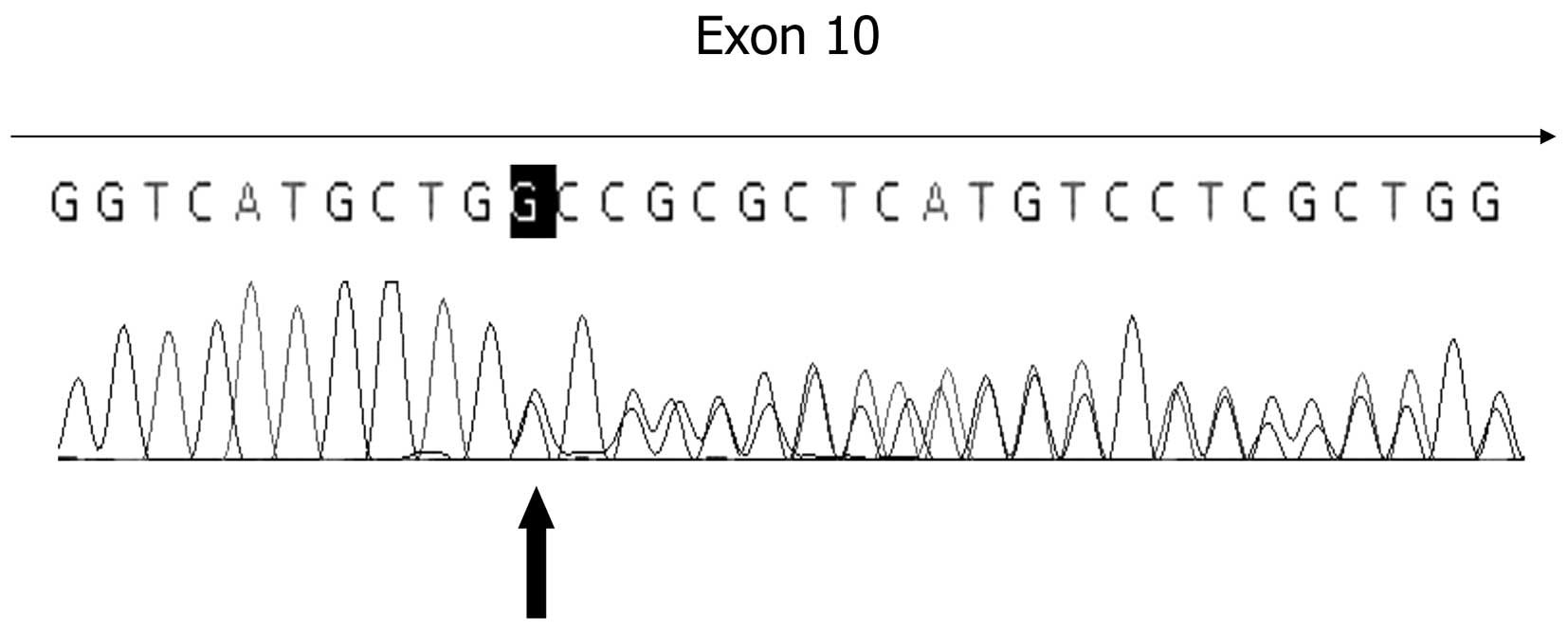
Direct sequencing of the SLC5A2 gene from the patient with PRG revealed a novel 1 bp deletion mutation, altering the coding sequence of exon 10 in the transmembrane domain (c.1162delG; Ala388ProfsX48; Fig. 1). The 1 bp deletion results in the frameshift mutation starting from 388th codon, which is truncated at the 48th codon from Ala388. Screening of the SLC5A2 gene in 50 normal control subjects revealed no mutant alleles in 100 screened chromosomes. SLC5A2 gene analysis suggested an autosomal dominant inheritance pattern.

Figure 1

Mutation analysis of the SLC5A2 gene from a patient with renal glucosuria restricted to a single individual or family. Direct sequencing of exon 10 reveals overlapped peaks (arrow) from nucleotide position 1162 due to a 1 bp deletion (c.1162delG; Ala388ProfsX48).

Discussion

In this study, a novel deletion mutation in the SLC5A2 gene in a patient with PRG, associated with benign clinical characteristics, is reported. The patient appeared healthy despite having had glucosuria since childhood and exhibited no ill effects of the glucosuria.

We speculate that glucosuria caused by carrying the SLC5A2 gene mutation may have a potentially beneficial effect on the healthy state. The persistent loss of calories and sodium may have a beneficial effect on lowering blood pressure and preventing obesity, although the majority of the sodium is reabsorbed by distal tubules (8). A pharmacological inhibitor of SGLT2 (sodium-glucose co-transporters inhibitor) has been evaluated as a useful drug for the treatment of obesity, diabetes, and hypertension with no significant toxic effects (9).

Among sodium/glucose transporters, SGLT2 is expressed almost exclusively in the kidney (10) and is encoded by the SLC5A2 gene, which is responsible for PRG. A large number of heterogeneous mutations have been reported in the SLC5A2 gene. However, previous reports have not observed an identifiable mutation in the SLC5A2 gene (2,3). This may be due to technical limitations related to mutational analysis. According to the previous reports, no clear association has been identified between genotype and phenotype in PRG, with the exception of a tendency for increased homozygous or compound heterozygous mutation frequency in patients exhibiting severe glucosuria.

Although PRG is a rare disease, many subjects with glucosuria without hyperglycemia have been confirmed by SLC5A2 gene analysis, as in the current case. In the present case, the c.1162delG mutation affects exon 10, including an alanine residue conserved in the entire transporter superfamily to which SGLT2 belongs, abolishing the expression of the glucose transporter. This finding is in agreement with previous studies, suggesting that SLC5A2 mutations have marked allelic heterogeneity, and the majority of mutations in PRG are restricted to a single individual or family (11).

Unfortunately, it was not possible to perform a family study; therefore, an evaluation of the mutational pattern of the patient to determine whether the mutation was de novo or inherited could not be conducted. Furthermore, it was not possible to induce information regarding the genotype-phenotype correlation, due to there only being one case. Despite the large deletion involving the SLC5A2 gene, the majority of mutations may be detected by sequencing analysis. As previously reported, compound heterozygotes that carry missense or truncated mutations consistently exhibited renal glucosuria due to SGLT2 dysfunction (2–7). Therefore, identification of the mutation that causes glucosuria may enable the establishment of a genotypic diagnosis of PRG, providing important information to families and physicians.

In conclusion, PRG should be considered when making a differential diagnosis of patients exhibiting unexplained renal glucosuria without hyperglycemia or hypoglycemia, and SLC5A2 gene analysis should be performed. Molecular diagnosis may be beneficial for the confirmation of renal glucosuria and in deciding interventional measures for the patient’s family members.

Acknowledgements

This study was supported by the Soonchunhyang University Research Fund.

References

1 

van den Heuvel LP, Assink K, Willemsen M and Monnens L: Autosomal recessive renal glucosuria attributable to a mutation in the sodium glucose cotransporter (SGLT2). Hum Genet. 111:544–547. 2002.PubMed/NCBI

2 

Santer R, Kinner M, Lassen CL, et al: Molecular analysis of the SGLT2 gene in patients with renal glucosuria. J Am Soc Nephrol. 14:2873–2882. 2003. View Article : Google Scholar : PubMed/NCBI

3 

Calado J, Loeffler J, Sakallioglu O, et al: Familial renal glucosuria: SLC5A2 mutation analysis and evidence of salt-wasting. Kidney Int. 69:852–855. 2006. View Article : Google Scholar : PubMed/NCBI

4 

Calado J, Soto K, Clemente C, Correia P and Rueff J: Novel compound heterozygous mutations in SLC5A2 are responsible for autosomal recessive renal glucosuria. Hum Genet. 114:314–316. 2004. View Article : Google Scholar : PubMed/NCBI

5 

Kleta R, Stuart C, Gill FA and Gahl WA: Renal glucosuria due to SGLT2 mutations. Mol Genet Metab. 82:56–58. 2004. View Article : Google Scholar : PubMed/NCBI

6 

Francis J, Zhang J, Farhi A, Carey H and Geller DS: A novel SGLT2 mutation in a patient with autosomal recessive renal glucosuria. Nephrol Dial Transplant. 19:2893–2895. 2004. View Article : Google Scholar : PubMed/NCBI

7 

Magen D, Sprecher E, Zelikovic I and Skorecki K: A novel missense mutation in SLC5A2 encoding SGLT2 underlies autosomal-recessive renal glucosuria and aminoaciduria. Kidney Int. 67:34–41. 2005. View Article : Google Scholar : PubMed/NCBI

8 

Cruz DN, Simon DB, Nelson-Williams C, et al: Mutations in the Na-Cl cotransporter reduce blood pressure in humans. Hypertension. 37:1458–1464. 2001. View Article : Google Scholar : PubMed/NCBI

9 

Chao EC and Henry RR: SGLT2 inhibition - a novel strategy for diabetes treatment. Nat Rev Drug Discov. 9:551–559. 2010. View Article : Google Scholar : PubMed/NCBI

10 

Wells RG, Pajor AM, Kanai Y, Turk E, Wright EM and Hediger MA: Cloning of a human kidney cDNA with similarity to the sodium-glucose cotransporter. Am J Physiol. 263:F459–465. 1992.PubMed/NCBI

11 

Calado J, Sznajer Y, Metzger D, et al: Twenty-one additional cases of familial renal glucosuria: absence of genetic heterogeneity, high prevalence of private mutations and further evidence of volume depletion. Nephrol Dial Transplant. 23:3874–3879. 2008.PubMed/NCBI

Related Articles

  • Abstract
  • View
  • Download
  • Twitter
Copy and paste a formatted citation
Spandidos Publications style
Lee Y: Clinical and genetic analysis in a patient with primary renal glucosuria: Identification of a novel mutation in the SLC5A2 gene. Exp Ther Med 6: 1532-1534, 2013.
APA
Lee, Y. (2013). Clinical and genetic analysis in a patient with primary renal glucosuria: Identification of a novel mutation in the SLC5A2 gene. Experimental and Therapeutic Medicine, 6, 1532-1534. https://doi.org/10.3892/etm.2013.1326
MLA
Lee, Y."Clinical and genetic analysis in a patient with primary renal glucosuria: Identification of a novel mutation in the SLC5A2 gene". Experimental and Therapeutic Medicine 6.6 (2013): 1532-1534.
Chicago
Lee, Y."Clinical and genetic analysis in a patient with primary renal glucosuria: Identification of a novel mutation in the SLC5A2 gene". Experimental and Therapeutic Medicine 6, no. 6 (2013): 1532-1534. https://doi.org/10.3892/etm.2013.1326
Copy and paste a formatted citation
x
Spandidos Publications style
Lee Y: Clinical and genetic analysis in a patient with primary renal glucosuria: Identification of a novel mutation in the SLC5A2 gene. Exp Ther Med 6: 1532-1534, 2013.
APA
Lee, Y. (2013). Clinical and genetic analysis in a patient with primary renal glucosuria: Identification of a novel mutation in the SLC5A2 gene. Experimental and Therapeutic Medicine, 6, 1532-1534. https://doi.org/10.3892/etm.2013.1326
MLA
Lee, Y."Clinical and genetic analysis in a patient with primary renal glucosuria: Identification of a novel mutation in the SLC5A2 gene". Experimental and Therapeutic Medicine 6.6 (2013): 1532-1534.
Chicago
Lee, Y."Clinical and genetic analysis in a patient with primary renal glucosuria: Identification of a novel mutation in the SLC5A2 gene". Experimental and Therapeutic Medicine 6, no. 6 (2013): 1532-1534. https://doi.org/10.3892/etm.2013.1326
Follow us
  • Twitter
  • LinkedIn
  • Facebook
About
  • Spandidos Publications
  • Careers
  • Cookie Policy
  • Privacy Policy
How can we help?
  • Help
  • Live Chat
  • Contact
  • Email to our Support Team