Spandidos Publications Logo
  • About
    • About Spandidos
    • Aims and Scopes
    • Abstracting and Indexing
    • Editorial Policies
    • Reprints and Permissions
    • Job Opportunities
    • Terms and Conditions
    • Contact
  • Journals
    • All Journals
    • Oncology Letters
      • Oncology Letters
      • Information for Authors
      • Editorial Policies
      • Editorial Board
      • Aims and Scope
      • Abstracting and Indexing
      • Bibliographic Information
      • Archive
    • International Journal of Oncology
      • International Journal of Oncology
      • Information for Authors
      • Editorial Policies
      • Editorial Board
      • Aims and Scope
      • Abstracting and Indexing
      • Bibliographic Information
      • Archive
    • Molecular and Clinical Oncology
      • Molecular and Clinical Oncology
      • Information for Authors
      • Editorial Policies
      • Editorial Board
      • Aims and Scope
      • Abstracting and Indexing
      • Bibliographic Information
      • Archive
    • Experimental and Therapeutic Medicine
      • Experimental and Therapeutic Medicine
      • Information for Authors
      • Editorial Policies
      • Editorial Board
      • Aims and Scope
      • Abstracting and Indexing
      • Bibliographic Information
      • Archive
    • International Journal of Molecular Medicine
      • International Journal of Molecular Medicine
      • Information for Authors
      • Editorial Policies
      • Editorial Board
      • Aims and Scope
      • Abstracting and Indexing
      • Bibliographic Information
      • Archive
    • Biomedical Reports
      • Biomedical Reports
      • Information for Authors
      • Editorial Policies
      • Editorial Board
      • Aims and Scope
      • Abstracting and Indexing
      • Bibliographic Information
      • Archive
    • Oncology Reports
      • Oncology Reports
      • Information for Authors
      • Editorial Policies
      • Editorial Board
      • Aims and Scope
      • Abstracting and Indexing
      • Bibliographic Information
      • Archive
    • Molecular Medicine Reports
      • Molecular Medicine Reports
      • Information for Authors
      • Editorial Policies
      • Editorial Board
      • Aims and Scope
      • Abstracting and Indexing
      • Bibliographic Information
      • Archive
    • World Academy of Sciences Journal
      • World Academy of Sciences Journal
      • Information for Authors
      • Editorial Policies
      • Editorial Board
      • Aims and Scope
      • Abstracting and Indexing
      • Bibliographic Information
      • Archive
    • International Journal of Functional Nutrition
      • International Journal of Functional Nutrition
      • Information for Authors
      • Editorial Policies
      • Editorial Board
      • Aims and Scope
      • Abstracting and Indexing
      • Bibliographic Information
      • Archive
    • International Journal of Epigenetics
      • International Journal of Epigenetics
      • Information for Authors
      • Editorial Policies
      • Editorial Board
      • Aims and Scope
      • Abstracting and Indexing
      • Bibliographic Information
      • Archive
    • Medicine International
      • Medicine International
      • Information for Authors
      • Editorial Policies
      • Editorial Board
      • Aims and Scope
      • Abstracting and Indexing
      • Bibliographic Information
      • Archive
  • Articles
  • Information
    • Information for Authors
    • Information for Reviewers
    • Information for Librarians
    • Information for Advertisers
    • Conferences
  • Language Editing
Spandidos Publications Logo
  • About
    • About Spandidos
    • Aims and Scopes
    • Abstracting and Indexing
    • Editorial Policies
    • Reprints and Permissions
    • Job Opportunities
    • Terms and Conditions
    • Contact
  • Journals
    • All Journals
    • Biomedical Reports
      • Information for Authors
      • Editorial Policies
      • Editorial Board
      • Aims and Scope
      • Abstracting and Indexing
      • Bibliographic Information
      • Archive
    • Experimental and Therapeutic Medicine
      • Information for Authors
      • Editorial Policies
      • Editorial Board
      • Aims and Scope
      • Abstracting and Indexing
      • Bibliographic Information
      • Archive
    • International Journal of Epigenetics
      • Information for Authors
      • Editorial Policies
      • Editorial Board
      • Aims and Scope
      • Abstracting and Indexing
      • Bibliographic Information
      • Archive
    • International Journal of Functional Nutrition
      • Information for Authors
      • Editorial Policies
      • Editorial Board
      • Aims and Scope
      • Abstracting and Indexing
      • Bibliographic Information
      • Archive
    • International Journal of Molecular Medicine
      • Information for Authors
      • Editorial Policies
      • Editorial Board
      • Aims and Scope
      • Abstracting and Indexing
      • Bibliographic Information
      • Archive
    • International Journal of Oncology
      • Information for Authors
      • Editorial Policies
      • Editorial Board
      • Aims and Scope
      • Abstracting and Indexing
      • Bibliographic Information
      • Archive
    • Medicine International
      • Information for Authors
      • Editorial Policies
      • Editorial Board
      • Aims and Scope
      • Abstracting and Indexing
      • Bibliographic Information
      • Archive
    • Molecular and Clinical Oncology
      • Information for Authors
      • Editorial Policies
      • Editorial Board
      • Aims and Scope
      • Abstracting and Indexing
      • Bibliographic Information
      • Archive
    • Molecular Medicine Reports
      • Information for Authors
      • Editorial Policies
      • Editorial Board
      • Aims and Scope
      • Abstracting and Indexing
      • Bibliographic Information
      • Archive
    • Oncology Letters
      • Information for Authors
      • Editorial Policies
      • Editorial Board
      • Aims and Scope
      • Abstracting and Indexing
      • Bibliographic Information
      • Archive
    • Oncology Reports
      • Information for Authors
      • Editorial Policies
      • Editorial Board
      • Aims and Scope
      • Abstracting and Indexing
      • Bibliographic Information
      • Archive
    • World Academy of Sciences Journal
      • Information for Authors
      • Editorial Policies
      • Editorial Board
      • Aims and Scope
      • Abstracting and Indexing
      • Bibliographic Information
      • Archive
  • Articles
  • Information
    • For Authors
    • For Reviewers
    • For Librarians
    • For Advertisers
    • Conferences
  • Language Editing
Login Register Submit
  • This site uses cookies
  • You can change your cookie settings at any time by following the instructions in our Cookie Policy. To find out more, you may read our Privacy Policy.

    I agree
Search articles by DOI, keyword, author or affiliation
Search
Advanced Search
presentation
Experimental and Therapeutic Medicine
Join Editorial Board Propose a Special Issue
Print ISSN: 1792-0981 Online ISSN: 1792-1015
Journal Cover
December 2013 Volume 6 Issue 6

Full Size Image

Sign up for eToc alerts
Recommend to Library

Journals

International Journal of Molecular Medicine

International Journal of Molecular Medicine

International Journal of Molecular Medicine is an international journal devoted to molecular mechanisms of human disease.

International Journal of Oncology

International Journal of Oncology

International Journal of Oncology is an international journal devoted to oncology research and cancer treatment.

Molecular Medicine Reports

Molecular Medicine Reports

Covers molecular medicine topics such as pharmacology, pathology, genetics, neuroscience, infectious diseases, molecular cardiology, and molecular surgery.

Oncology Reports

Oncology Reports

Oncology Reports is an international journal devoted to fundamental and applied research in Oncology.

Experimental and Therapeutic Medicine

Experimental and Therapeutic Medicine

Experimental and Therapeutic Medicine is an international journal devoted to laboratory and clinical medicine.

Oncology Letters

Oncology Letters

Oncology Letters is an international journal devoted to Experimental and Clinical Oncology.

Biomedical Reports

Biomedical Reports

Explores a wide range of biological and medical fields, including pharmacology, genetics, microbiology, neuroscience, and molecular cardiology.

Molecular and Clinical Oncology

Molecular and Clinical Oncology

International journal addressing all aspects of oncology research, from tumorigenesis and oncogenes to chemotherapy and metastasis.

World Academy of Sciences Journal

World Academy of Sciences Journal

Multidisciplinary open-access journal spanning biochemistry, genetics, neuroscience, environmental health, and synthetic biology.

International Journal of Functional Nutrition

International Journal of Functional Nutrition

Open-access journal combining biochemistry, pharmacology, immunology, and genetics to advance health through functional nutrition.

International Journal of Epigenetics

International Journal of Epigenetics

Publishes open-access research on using epigenetics to advance understanding and treatment of human disease.

Medicine International

Medicine International

An International Open Access Journal Devoted to General Medicine.

Journal Cover
December 2013 Volume 6 Issue 6

Full Size Image

Sign up for eToc alerts
Recommend to Library

  • Article
  • Citations
    • Cite This Article
    • Download Citation
    • Create Citation Alert
    • Remove Citation Alert
    • Cited By
  • Similar Articles
    • Related Articles (in Spandidos Publications)
    • Similar Articles (Google Scholar)
    • Similar Articles (PubMed)
  • Download PDF
  • Download XML
  • View XML
Case Report

Peptide nucleic acid clamp polymerase chain reaction reveals a deletion mutation of the BRAF gene in papillary thyroid carcinoma: A case report

  • Authors:
    • Yong-Wha Lee
  • View Affiliations / Copyright

    Affiliations: Department of Laboratory Medicine and Genetics, Soonchunhyang University Bucheon Hospital and Soonchunhyang University College of Medicine, Bucheon, Gyeonggi 420-767, Republic of Korea
  • Pages: 1550-1552
    |
    Published online on: October 8, 2013
       https://doi.org/10.3892/etm.2013.1332
  • Expand metrics +
Metrics: Total Views: 0 (Spandidos Publications: | PMC Statistics: )
Metrics: Total PDF Downloads: 0 (Spandidos Publications: | PMC Statistics: )
Cited By (CrossRef): 0 citations Loading Articles...

This article is mentioned in:


Abstract

The BRAF point mutation is the most common genetic event in papillary thyroid carcinoma (PTC), occurring in 29-69% of such tumors. The V600E mutation accounts for up to 95% of all BRAF mutations. Therefore, the majority of diagnostic assays have been developed to detect only the V600E mutation of the BRAF gene. A peptide nucleic-acid (PNA)-clamp quantitative polymerase chain reaction (qPCR) was developed to detect the V600E mutation and other mutations in the BRAF gene. In this study, a 3-bp deletion mutation (c.1799_ 1801delTGA) was detected in a subject with a PTC by PNA clamp qPCR, in contrast with the results of allele‑specific (AS)-PCR. The mutant allele was not detected by AS-PCR, but was detected using PNA-clamp PCR. The atypical 3-bp deletion mutation (c.1799_1801delTGA) was identified by confirmatory PCR combined with sequencing. The conversion of codons 600 (GTG) and 601 (AAA) into a single codon (GAA) resulted in the insertion of a glutamic acid residue into the activation segment of the B-raf protein (p.V600_K601delinsE). In cases where PTC is highly suspected but no mutation is detected by AS-PCR specific for V600E, PNA clamp qPCR, which is complementary to other sequencing methods, should be performed in order to detect other mutations in the BRAF gene.

Introduction

Various oncogenes and tumor suppressor genes regulate the development and progression of papillary thyroid carcinoma (PTC). However, few of these have been identified to date (1). Numerous tumors have a thymine (T) to adenine (A) transversion at nucleotide position 1799 (T1799A) of the BRAF gene, resulting in a valine (V) to glutamate (E) substitution at residue 600 (V600E) (2,3). This BRAF point mutation is the most common genetic event in PTC, occurring in 29–69% of such tumors (4). The incidence rate of BRAF V600E in Korean patients with PTC is relatively high compared with that in other countries (5–7). Few other BRAF mutations have been documented. Therefore, the majority of diagnostic assays, including allele-specific (AS) amplification and quantitative polymerase chain reaction (qPCR) assays, have been developed to detect only the V600E mutation of the BRAF gene.

A peptide nucleic acid (PNA) clamp qPCR assay was developed to detect not only the V600E mutation but also other mutations in the BRAF gene. This method is based on the use of a PNA probe that inhibits the amplification of the wild-type allele while enabling the extension of mutant alleles. In this study, a 3-bp deletion mutation (c.1799_1801delTGA) was identified in a subject with a PTC by PNA clamp qPCR, in contrast with the results obtained by AS-PCR, which did not detect the mutation.

Case report

A 69-yr-old female patient was transferred from the local clinic to Soonchunhyang University Bucheon Hospital (Bucheon, Korea) in order to evaluate thyroid masses detected with thyroid ultrasonography. The largest mass was isoechoic, and measured ~0.9×1.2 cm, with a benign nature among multiple masses in both lobes. A smaller nodule sized mass of 0.7×1.0 cm located in the lower pole of the left lobe was hypoechoic, ill-defined and solid, and suspected to be malignant. Fine-needle aspiration cytology and BRAF mutational analysis were performed on the suspicious lesion.

A thyroid aspiration sample was obtained from the patient after obtaining informed consent. Genomic DNA was isolated from the sample using the QIAamp® DNA Mini kit (Qiagen, Chatsworth, CA, USA). AS-PCR was performed to detect mutant alleles in the BRAF gene using the Anyplex™ BRAF V600E Real-time Detection kit (Seegene, Seoul, Korea) according to the manufacturer’s instructions. PCR was performed in a total volume of 20 μl containing 50 ng DNA and 15 μl PCR master mix. PCR cycling was performed at 95°C for 15 min followed by 15 cycles at 95°C for 15 sec and 60°C for 30 sec, and 35 cycles at 95°C for 30 sec and 60°C for 32 sec. The fluorephores, 6-carboxyfluorescein (FAM) probe was designed to hybridize completely to the V600E allele of the BRAF gene. The Quasar 670 probe (Seegene) was used for hybridization with an internal control. The threshold cycle (Ct) was automatically calculated from PCR amplification plots, in which fluorescence was plotted against the number of cycles. If the Ct of the FAM probe was <33 and the Ct of Quasar 670 was <30, the BRAF mutation was determined to be positive, according to the instructions. A Ct value >33, characteristic of the wild-type sequence, was calculated in this study.

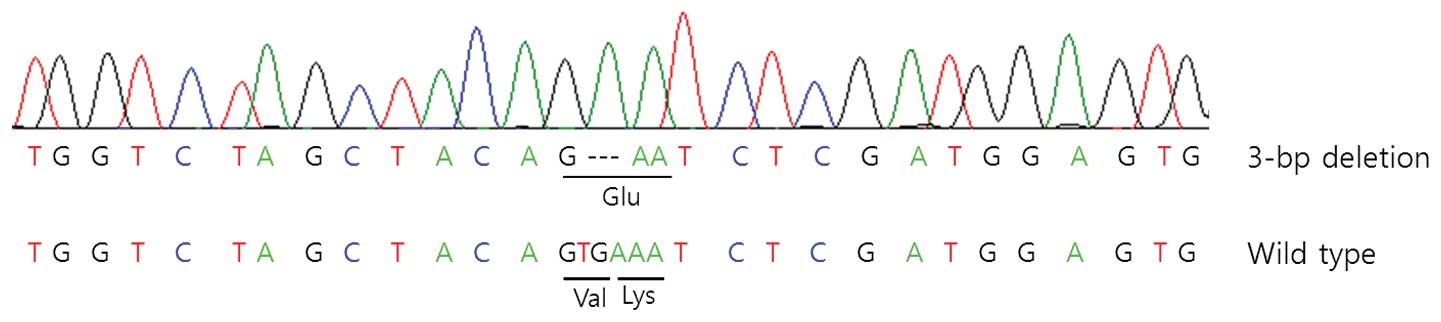
In order to investigate the possibility of other BRAF mutations, PNA clamp qPCR was performed using the PNA Clamp BRAF Mutation Detection kit (Panagene Inc., Daejeon, Korea) according to the manufacturer’s instructions. PCR was performed in a total volume of 20 μl containing 50 ng DNA, 13-μl real-time SYBR-Green PCR master mix and each of the primers and PNA probes for codon 600. The primers and PNA probes for codon 600 were included in the PNA Clamp BRAF Mutation Detection kit. The PCR control lacked a PNA probe and contained the wild-type template. PCR cycling conditions were performed at 94°C for 5 min followed by 40 cycles at 94°C for 30 sec, 70°C for 20 sec, 63°C for 30 sec and 72°C for 30 sec, and a final extension at 72°C for 5 min. The PNA probe was designed to hybridize completely to the wild-type BRAF allele. PNA probe hybridization securely inhibited amplification of the wild-type BRAF allele, whereas the PNA/mutant allele hybrid was unstable due to a base pair mismatch and therefore did not inhibit extension by Taq polymerase. The Ct was automatically calculated from PCR amplification plots in which fluorescence was plotted against the number of cycles. The change in Ct values (ΔCt) = Ct value of the sample - the Ct value of the control. A higher ΔCt value meant that the mutant was amplified more efficiently. A cut-off value of 2.0 was used to determine the presence of mutant DNA. The ΔCt was of the sample from the patient was 8.39, suggestive of a definite BRAF mutation, in contrast with the AS-PCR results. In order to confirm this observation, PCR and sequencing of the BRAF gene was performed. For PCR, two generic primers and a blocking primer were used to amplify exon 15 of BRAF. Generic primers were as follows: forward: 5′-CAG TAA AAA TAG GTG ATT TTG GTC TAG C-3′; reverse : 5′-CTG ATT TTT GTG AAT ACT GGG AAC T-3′. Blocking primers were as follows: 5′-GGT GAT TTT GGT CTA GCT ACA GTG A-3′. Exon 15 was analyzed since the majority of BRAF mutations, including V600E, occur within exon 15 of the BRAF gene. The amplification product (5 μl) was treated with 2 units shrimp alkaline phosphatase and 10 units exonuclease I (USB Corp., Cleveland, OH, USA). Direct sequencing was performed using the BigDye Terminator Cycle Sequencing Ready Reaction kit on an ABI Prism 3130 Genetic analyzer (Applied Biosystems, Foster City, CA, USA). The obtained sequences were analyzed and compared with a reference sequence (NM_004333.4). A 3-bp deletion mutation in coding nucleotides 1799 to 1801 (c.1799_1801delTGA) within the BRAF mutational hotspot region was identified (Fig. 1). The conversion of codons 600 (GTG) and 601 (AAA) into a single codon (GAA) resulted in the insertion of a glutamic acid into the activation segment of the B-raf protein (p.V600_K601delinsE).

Figure 1

Mutation analysis of the BRAF gene from a patient with papillary thyroid carcinoma. Direct sequencing of exon 15 following mutant enrichment with 3′-modified oligonucleotide polymerase chain reaction (PCR) shows a 3-bp deletion (arrow) from nucleotide positions 1799 to 1801 (c.1799_1801delTGA).

A total thyroidectomy with dissection of cervical lymph nodes was performed on the patient for PTC. Pathological findings of the nodule revealed classical PTC. The gross surface of the lesions were ill-defined with a hard consistency and measured 1.2×0.9 cm in the lower pole of the left lobe. No metastasis was detected in the four resected lymph nodes. The study was approved by the ethics committee of the Institutional Review Board of Soonchunhyang University Bucheon Hospital (Bucheon, Korea).

Discussion

In this study, a rare deletion mutation that was undetectable by AS-PCR was identified. The 3-bp deletion mutation (c.1799_1801delTGA) detected in this study has been reported in other studies concerning thyroid cancer and other malignancies (8,9). Rare BRAF mutations in PTC have been summarized in a previous study (10) and on an online database (www.sanger.ac.uk/genetics/CGP/cosmic). Jung et al reported four cases with unusual BRAF mutations (excluding V600E) in 1,041 patients with PTC (11). In the present study, another case of a BRAF deletion mutation in PTC was identified. In this case, the pathology of the carcinoma was of the classic papillary type.

Numerous laboratories perform screenings specifically for BRAF V600E, which is the most common mutation in PTC, using AS-PCR or other amplification methods. However, these initial screenings may consider a deletion or other mutations in exon 15 of the BRAF gene (excluding the thymidine to adenine substitution at nucleotide position 1799) as the wild-type BRAF gene, as described in this study. Therefore, the use of other analytical methods, which are capable of detecting a variety of atypical mutations in the BRAF gene, is important for the evaluation of the biological characteristics, pathological features and clinical behaviors of tumors harboring BRAF mutations. There are a number of moderate to highly sensitive PCR methods for mutant amplification that block normal allele amplification, including PCR clamping mediated by PNA or locked nucleic acid (LNA), amplification refractory mutation system PCR and thermostable restriction endonuclease-mediated selective PCR (12). PCR clamping by PNA is a simple and sensitive mutant amplification technique, based on inhibition of the amplification of the normal allele due to the strong binding of the PNA probe to the wild-type allele. If a BRAF mutant is present, the binding capacity of the PNA probe for the mutant allele is weaker than for the wild-type allele, as nucleotides of the mutant allele do not match the PNA probe. Consequentially, a BRAF mutation may be selectively amplified; therefore, this method is useful for detecting mutant alleles, even if they are present at low concentrations in the tissue. This analytical technique is easier to design, compared with previous methods, and may be applicable to the clinical and diagnostic screening of PTC. The mutant amplification efficiency of PNA-clamp qPCR is comparable to that of PCR combined with sequencing when the reaction conditions are optimized (13). In the present study, the sequencing method successfully detected an atypical BRAF deletion mutation.

In conclusion, PNA-clamp qPCR was used to detect a rare 3-bp deletion in coding nucleotides 1799 to 1801 in the BRAF gene in a PTC patient. In cases where PTC is highly suspected, but no mutation is detected using AS-PCR specific for V600E, the use of PNA clamp qPCR (which is complementary to the sequencing method) to detect other mutations in the BRAF gene is recommended.

Acknowledgements

This study was supported by the Soonchunhyang University Research Fund.

References

1 

Segev DL, Umbricht C and Zeiger MA: Molecular pathogenesis of thyroid cancer. Surg Oncol. 12:69–90. 2003. View Article : Google Scholar : PubMed/NCBI

2 

Davies H, Bignell GR, Cox C, et al: Mutations of the BRAF gene in human cancer. Nature. 417:949–954. 2002. View Article : Google Scholar : PubMed/NCBI

3 

Michaloglou C, Vredeveld LC, Mooi WJ and Peeper DS: BRAF(E600) in benign and malignant human tumours. Oncogene. 27:877–895. 2008. View Article : Google Scholar : PubMed/NCBI

4 

Xing M: BRAF mutation in papillary thyroid cancer: pathogenic role, molecular bases, and clinical implications. Endocr Rev. 28:742–762. 2007. View Article : Google Scholar : PubMed/NCBI

5 

Kim SK, Kim DL, Han HS, et al: Pyrosequencing analysis for detection of a BRAFV600E mutation in an FNAB specimen of thyroid nodules. Diagn Mol Pathol. 17:118–125. 2008. View Article : Google Scholar : PubMed/NCBI

6 

Park SY, Park YJ, Lee YJ, et al: Analysis of differential BRAF(V600E) mutational status in multifocal papillary thyroid carcinoma: evidence of independent clonal origin in distinct tumor foci. Cancer. 107:1831–1838. 2006. View Article : Google Scholar : PubMed/NCBI

7 

Chung KW, Yang SK, Lee GK, et al: Detection of BRAFV600E mutation on fine needle aspiration specimens of thyroid nodule refines cyto-pathology diagnosis, especially in BRAF600E mutation-prevalent area. Clin Endocrinol (Oxf). 65:660–666. 2006. View Article : Google Scholar : PubMed/NCBI

8 

Trovisco V, Soares P, Soares R, Magalhães J, Sá-Couto P and Sobrinho-Simões M: A new BRAF gene mutation detected in a case of a solid variant of papillary thyroid carcinoma. Hum Pathol. 36:694–697. 2005. View Article : Google Scholar : PubMed/NCBI

9 

Reifenberger J, Knobbe CB, Sterzinger AA, et al: Frequent alterations of Ras signaling pathway genes in sporadic malignant melanomas. Int J Cancer. 109:377–384. 2004. View Article : Google Scholar : PubMed/NCBI

10 

Chiosea S, Nikiforova M, Zuo H, et al: A novel complex BRAF mutation detected in a solid variant of papillary thyroid carcinoma. Endocr Pathol. 20:122–126. 2009. View Article : Google Scholar : PubMed/NCBI

11 

Jung CK, Im SY, Kang YJ, et al: Mutational patterns and novel mutations of the BRAF gene in a large cohort of Korean patients with papillary thyroid carcinoma. Thyroid. 22:791–797. 2012. View Article : Google Scholar : PubMed/NCBI

12 

Milbury CA, Li J and Makrigiorgos GM: PCR-based methods for the enrichment of minority alleles and mutations. Clin Chem. 55:632–640. 2009. View Article : Google Scholar : PubMed/NCBI

13 

Lee ST, Kim JY, Kown MJ, et al: Mutant enrichment with 3′-modified oligonucleotides a practical PCR method for detecting trace mutant DNAs. J Mol Diagn. 13:657–668. 2011.

Related Articles

  • Abstract
  • View
  • Download
  • Twitter
Copy and paste a formatted citation
Spandidos Publications style
Lee Y: Peptide nucleic acid clamp polymerase chain reaction reveals a deletion mutation of the BRAF gene in papillary thyroid carcinoma: A case report. Exp Ther Med 6: 1550-1552, 2013.
APA
Lee, Y. (2013). Peptide nucleic acid clamp polymerase chain reaction reveals a deletion mutation of the BRAF gene in papillary thyroid carcinoma: A case report. Experimental and Therapeutic Medicine, 6, 1550-1552. https://doi.org/10.3892/etm.2013.1332
MLA
Lee, Y."Peptide nucleic acid clamp polymerase chain reaction reveals a deletion mutation of the BRAF gene in papillary thyroid carcinoma: A case report". Experimental and Therapeutic Medicine 6.6 (2013): 1550-1552.
Chicago
Lee, Y."Peptide nucleic acid clamp polymerase chain reaction reveals a deletion mutation of the BRAF gene in papillary thyroid carcinoma: A case report". Experimental and Therapeutic Medicine 6, no. 6 (2013): 1550-1552. https://doi.org/10.3892/etm.2013.1332
Copy and paste a formatted citation
x
Spandidos Publications style
Lee Y: Peptide nucleic acid clamp polymerase chain reaction reveals a deletion mutation of the BRAF gene in papillary thyroid carcinoma: A case report. Exp Ther Med 6: 1550-1552, 2013.
APA
Lee, Y. (2013). Peptide nucleic acid clamp polymerase chain reaction reveals a deletion mutation of the BRAF gene in papillary thyroid carcinoma: A case report. Experimental and Therapeutic Medicine, 6, 1550-1552. https://doi.org/10.3892/etm.2013.1332
MLA
Lee, Y."Peptide nucleic acid clamp polymerase chain reaction reveals a deletion mutation of the BRAF gene in papillary thyroid carcinoma: A case report". Experimental and Therapeutic Medicine 6.6 (2013): 1550-1552.
Chicago
Lee, Y."Peptide nucleic acid clamp polymerase chain reaction reveals a deletion mutation of the BRAF gene in papillary thyroid carcinoma: A case report". Experimental and Therapeutic Medicine 6, no. 6 (2013): 1550-1552. https://doi.org/10.3892/etm.2013.1332
Follow us
  • Twitter
  • LinkedIn
  • Facebook
About
  • Spandidos Publications
  • Careers
  • Cookie Policy
  • Privacy Policy
How can we help?
  • Help
  • Live Chat
  • Contact
  • Email to our Support Team