Spandidos Publications Logo
  • About
    • About Spandidos
    • Aims and Scopes
    • Abstracting and Indexing
    • Editorial Policies
    • Reprints and Permissions
    • Job Opportunities
    • Terms and Conditions
    • Contact
  • Journals
    • All Journals
    • Oncology Letters
      • Oncology Letters
      • Information for Authors
      • Editorial Policies
      • Editorial Board
      • Aims and Scope
      • Abstracting and Indexing
      • Bibliographic Information
      • Archive
    • International Journal of Oncology
      • International Journal of Oncology
      • Information for Authors
      • Editorial Policies
      • Editorial Board
      • Aims and Scope
      • Abstracting and Indexing
      • Bibliographic Information
      • Archive
    • Molecular and Clinical Oncology
      • Molecular and Clinical Oncology
      • Information for Authors
      • Editorial Policies
      • Editorial Board
      • Aims and Scope
      • Abstracting and Indexing
      • Bibliographic Information
      • Archive
    • Experimental and Therapeutic Medicine
      • Experimental and Therapeutic Medicine
      • Information for Authors
      • Editorial Policies
      • Editorial Board
      • Aims and Scope
      • Abstracting and Indexing
      • Bibliographic Information
      • Archive
    • International Journal of Molecular Medicine
      • International Journal of Molecular Medicine
      • Information for Authors
      • Editorial Policies
      • Editorial Board
      • Aims and Scope
      • Abstracting and Indexing
      • Bibliographic Information
      • Archive
    • Biomedical Reports
      • Biomedical Reports
      • Information for Authors
      • Editorial Policies
      • Editorial Board
      • Aims and Scope
      • Abstracting and Indexing
      • Bibliographic Information
      • Archive
    • Oncology Reports
      • Oncology Reports
      • Information for Authors
      • Editorial Policies
      • Editorial Board
      • Aims and Scope
      • Abstracting and Indexing
      • Bibliographic Information
      • Archive
    • Molecular Medicine Reports
      • Molecular Medicine Reports
      • Information for Authors
      • Editorial Policies
      • Editorial Board
      • Aims and Scope
      • Abstracting and Indexing
      • Bibliographic Information
      • Archive
    • World Academy of Sciences Journal
      • World Academy of Sciences Journal
      • Information for Authors
      • Editorial Policies
      • Editorial Board
      • Aims and Scope
      • Abstracting and Indexing
      • Bibliographic Information
      • Archive
    • International Journal of Functional Nutrition
      • International Journal of Functional Nutrition
      • Information for Authors
      • Editorial Policies
      • Editorial Board
      • Aims and Scope
      • Abstracting and Indexing
      • Bibliographic Information
      • Archive
    • International Journal of Epigenetics
      • International Journal of Epigenetics
      • Information for Authors
      • Editorial Policies
      • Editorial Board
      • Aims and Scope
      • Abstracting and Indexing
      • Bibliographic Information
      • Archive
    • Medicine International
      • Medicine International
      • Information for Authors
      • Editorial Policies
      • Editorial Board
      • Aims and Scope
      • Abstracting and Indexing
      • Bibliographic Information
      • Archive
  • Articles
  • Information
    • Information for Authors
    • Information for Reviewers
    • Information for Librarians
    • Information for Advertisers
    • Conferences
  • Language Editing
Spandidos Publications Logo
  • About
    • About Spandidos
    • Aims and Scopes
    • Abstracting and Indexing
    • Editorial Policies
    • Reprints and Permissions
    • Job Opportunities
    • Terms and Conditions
    • Contact
  • Journals
    • All Journals
    • Biomedical Reports
      • Information for Authors
      • Editorial Policies
      • Editorial Board
      • Aims and Scope
      • Abstracting and Indexing
      • Bibliographic Information
      • Archive
    • Experimental and Therapeutic Medicine
      • Information for Authors
      • Editorial Policies
      • Editorial Board
      • Aims and Scope
      • Abstracting and Indexing
      • Bibliographic Information
      • Archive
    • International Journal of Epigenetics
      • Information for Authors
      • Editorial Policies
      • Editorial Board
      • Aims and Scope
      • Abstracting and Indexing
      • Bibliographic Information
      • Archive
    • International Journal of Functional Nutrition
      • Information for Authors
      • Editorial Policies
      • Editorial Board
      • Aims and Scope
      • Abstracting and Indexing
      • Bibliographic Information
      • Archive
    • International Journal of Molecular Medicine
      • Information for Authors
      • Editorial Policies
      • Editorial Board
      • Aims and Scope
      • Abstracting and Indexing
      • Bibliographic Information
      • Archive
    • International Journal of Oncology
      • Information for Authors
      • Editorial Policies
      • Editorial Board
      • Aims and Scope
      • Abstracting and Indexing
      • Bibliographic Information
      • Archive
    • Medicine International
      • Information for Authors
      • Editorial Policies
      • Editorial Board
      • Aims and Scope
      • Abstracting and Indexing
      • Bibliographic Information
      • Archive
    • Molecular and Clinical Oncology
      • Information for Authors
      • Editorial Policies
      • Editorial Board
      • Aims and Scope
      • Abstracting and Indexing
      • Bibliographic Information
      • Archive
    • Molecular Medicine Reports
      • Information for Authors
      • Editorial Policies
      • Editorial Board
      • Aims and Scope
      • Abstracting and Indexing
      • Bibliographic Information
      • Archive
    • Oncology Letters
      • Information for Authors
      • Editorial Policies
      • Editorial Board
      • Aims and Scope
      • Abstracting and Indexing
      • Bibliographic Information
      • Archive
    • Oncology Reports
      • Information for Authors
      • Editorial Policies
      • Editorial Board
      • Aims and Scope
      • Abstracting and Indexing
      • Bibliographic Information
      • Archive
    • World Academy of Sciences Journal
      • Information for Authors
      • Editorial Policies
      • Editorial Board
      • Aims and Scope
      • Abstracting and Indexing
      • Bibliographic Information
      • Archive
  • Articles
  • Information
    • For Authors
    • For Reviewers
    • For Librarians
    • For Advertisers
    • Conferences
  • Language Editing
Login Register Submit
  • This site uses cookies
  • You can change your cookie settings at any time by following the instructions in our Cookie Policy. To find out more, you may read our Privacy Policy.

    I agree
Search articles by DOI, keyword, author or affiliation
Search
Advanced Search
presentation
Molecular and Clinical Oncology
Join Editorial Board Propose a Special Issue
Print ISSN: 2049-9450 Online ISSN: 2049-9469
Journal Cover
May-2015 Volume 3 Issue 3

Full Size Image

Sign up for eToc alerts
Recommend to Library

Journals

International Journal of Molecular Medicine

International Journal of Molecular Medicine

International Journal of Molecular Medicine is an international journal devoted to molecular mechanisms of human disease.

International Journal of Oncology

International Journal of Oncology

International Journal of Oncology is an international journal devoted to oncology research and cancer treatment.

Molecular Medicine Reports

Molecular Medicine Reports

Covers molecular medicine topics such as pharmacology, pathology, genetics, neuroscience, infectious diseases, molecular cardiology, and molecular surgery.

Oncology Reports

Oncology Reports

Oncology Reports is an international journal devoted to fundamental and applied research in Oncology.

Experimental and Therapeutic Medicine

Experimental and Therapeutic Medicine

Experimental and Therapeutic Medicine is an international journal devoted to laboratory and clinical medicine.

Oncology Letters

Oncology Letters

Oncology Letters is an international journal devoted to Experimental and Clinical Oncology.

Biomedical Reports

Biomedical Reports

Explores a wide range of biological and medical fields, including pharmacology, genetics, microbiology, neuroscience, and molecular cardiology.

Molecular and Clinical Oncology

Molecular and Clinical Oncology

International journal addressing all aspects of oncology research, from tumorigenesis and oncogenes to chemotherapy and metastasis.

World Academy of Sciences Journal

World Academy of Sciences Journal

Multidisciplinary open-access journal spanning biochemistry, genetics, neuroscience, environmental health, and synthetic biology.

International Journal of Functional Nutrition

International Journal of Functional Nutrition

Open-access journal combining biochemistry, pharmacology, immunology, and genetics to advance health through functional nutrition.

International Journal of Epigenetics

International Journal of Epigenetics

Publishes open-access research on using epigenetics to advance understanding and treatment of human disease.

Medicine International

Medicine International

An International Open Access Journal Devoted to General Medicine.

Journal Cover
May-2015 Volume 3 Issue 3

Full Size Image

Sign up for eToc alerts
Recommend to Library

  • Article
  • Citations
    • Cite This Article
    • Download Citation
    • Create Citation Alert
    • Remove Citation Alert
    • Cited By
  • Similar Articles
    • Related Articles (in Spandidos Publications)
    • Similar Articles (Google Scholar)
    • Similar Articles (PubMed)
  • Download PDF
  • Download XML
  • View XML
Article

Comparison of surgical techniques for stoma closure: A retrospective study of purse‑string skin closure versus conventional skin closure following ileostomy and colostomy reversal

  • Authors:
    • Yuma Wada
    • Norikatsu Miyoshi
    • Masayuki Ohue
    • Shingo Noura
    • Shiki Fujino
    • Keijirou Sugimura
    • Hirofumi Akita
    • Masaaki Motoori
    • Kunihito Gotoh
    • Hidenori Takahashi
    • Shogo Kobayashi
    • Takeshi Ohmori
    • Yoshiyuki Fujiwara
    • Masahiko Yano
  • View Affiliations / Copyright

    Affiliations: Department of Surgery, Osaka Medical Center for Cancer and Cardiovascular Diseases, Osaka 537‑8511, Japan
  • Pages: 619-622
    |
    Published online on: February 6, 2015
       https://doi.org/10.3892/mco.2015.505
  • Expand metrics +
Metrics: Total Views: 0 (Spandidos Publications: | PMC Statistics: )
Metrics: Total PDF Downloads: 0 (Spandidos Publications: | PMC Statistics: )
Cited By (CrossRef): 0 citations Loading Articles...

This article is mentioned in:


Abstract

The aim of this study was to compare the incidence of postoperative complications, including superficial incisional surgical site infection (SSI) following purse‑string skin closure (PS) and conventional skin closure with a drainage tube (CD) following stoma closure. A total of 55 consecutive patients who underwent loop colostomy and loop ileostomy closures in our hospital between October, 2011 and September, 2014 were retrospectively assessed. The patients were divided into two groups, namely the PS group (26 patients) and the CD group (29 patients). There were no significant differences in the characteristics of the patients between the two groups. The baseline and operative characteristics also did not differ significantly between the two groups. However, the incidence of superficial incisional SSI was lower in the PS group compared to that in the CD group (0 vs. 13.8%, respectively; P=0.049). The overall incidence of complications did not differ significantly between the two groups (P=0.313). The duration of postoperative hospital stay in the PS group was shorter compared to that in the CD group. In conclusion, the results of this study suggest that PS may an effective technique to reduce the incidence of superficial incisional SSI. This technique appears to be superior to the conventional technique, allowing for better cosmesis.

Introduction

Stoma closure is considered a minimally invasive surgery; however, surgical site infection (SSI) is a frequent complication. Recently, the number of cases of diverting ileostomy has increased due to the increase in the number of anal-preserving surgeries, such as super-low anterior resection (sLAR) and intersphincteric resection (ISR) for rectal cancer. In this study, we focused on methods used to decrease the incidence of SSI in stoma closure.

The incidence of wound infection following stoma closure ranges between 2 and 41% across different studies (1,2). The most frequent cause of wound infection is bacterial contamination of the skin surrounding the ileostomy/colostomy due to prolonged contact with bowel contents or due to leakage of the ileostomy contents. A previous study in 1997 introduced a purse-string skin closure technique (PS) for ileostomy reversal, which reduced the risk of wound infection and resulted in smaller scars, allowing for better cosmesis (3).

The number of studies investigating the effectiveness of PS is currently limited. We previously used a Penrose drainage tube under the subcutaneous tissue to prevent SSI and have reported the efficacy of this technique in our hospital (4).

PS was reported to be better for controlling superficial incisional SSI (5,6) and we introduced this technique in June, 2013. In the present study, we examined surgical techniques by either conventional skin closure with a drainage tube (CD) or PS and compared the incidence of superficial incisional SSI between CD and PS in order to assess the efficacy of the PS in ileostomy and colostomy reversal.

Patients and methods

Patients

We retrospectively reviewed the medical records of 55 consecutive patients who underwent stoma closure. A total of 26 patients who underwent PS between June, 2013 and September, 2014 were compared to 29 patients who underwent CD between October, 2011 and May, 2013 at the Osaka Medical Center for Cancer and Cardiovascular Diseases, Japan. Medical charts were reviewed for patient demographics, including age, gender and body mass index; past medical history, such as the presence of diabetes, chronic obstructive pulmonary disease, cardiovascular disease and liver dysfunction; alcohol consumption (regular vs. moderate or non-drinker), smoking status (smoked within 1 year prior to the operation), medication records, including perioperative steroid replacement; American Society of Anesthesiology (ASA) score; and preoperative serum albumin values for the CD and PS groups.

This study was approved by the Institutional Review Board of Osaka Medical Center for Cancer and Cardiovascular Diseases and written informed consent was obtained from all the patients.

Diagnosis of SSI

Wound infection was defined as the presence of cellulitis or purulent discharge, with or without positive bacterial growth, within 30 days after the operation (adopted from the 1992 Centers for Disease Control and Prevention definition of SSI) (Table I). The surgical wounds were routinely observed and evaluated by the surgical team and surveyed until 30 days after the operation.

Table I.

Centers for Disease Control and Prevention guidelines for the diagnosis of superfi cial SSI.

Table I.

Centers for Disease Control and Prevention guidelines for the diagnosis of superfi cial SSI.

Characteristics of superfcial SSI
1.Purulent drainage, with or without laboratory confrmation, from the superfcial incision.
2.Organisms isolated from an aseptically-obtained culture of fuid or tissue from the superfcial incision.
3.At least one of the following signs or symptoms of infection: Pain or tenderness, localized swelling, redness or heat and and superfcial incision deliberately opened by surgeon, unless the incision is culture-negative.
4.Diagnosis of superfcial incisional SSI by the surgeon or attending physician.

[i] Superfcial SSI occurs within 30 days of an operation and involves only the skin or subcutaneous tissue surrounding the incision and at least one of the abovementioned characteristics. SSI, surgical site infection.

Surgical technique

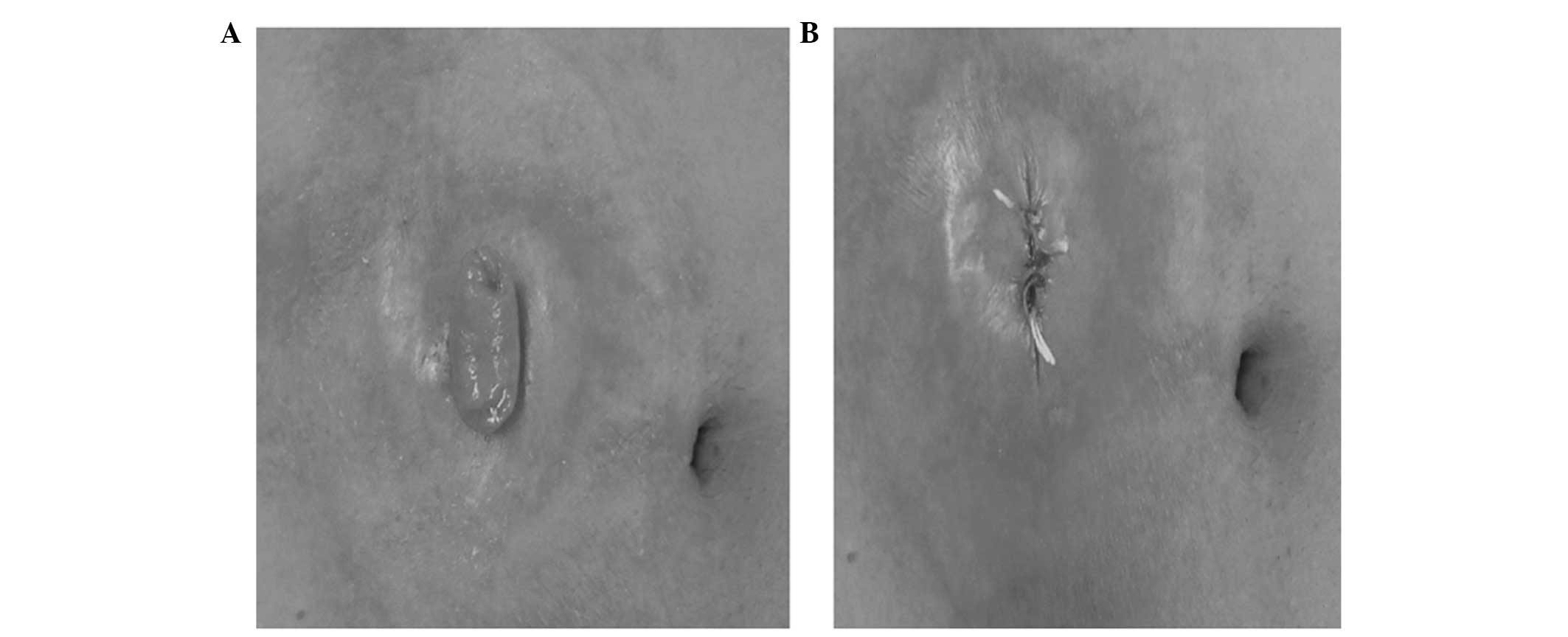
All the patients underwent preoperative mechanical bowel preparation. After the induction of general anesthesia, prophylactic antibiosis (Cefmetazole, 2 g/day) was administered. An open-ileostomy/colostomy was sutured (Fig. 1A and B) and the wound was irrigated by povidone iodine and 500 ml of saline. The skin around the sutured stoma was resected, maintaining a ~3–5 mm margin. The intestinal tracts leading to the stoma were extracted from the abdominal cavity and dissection of the sutured stoma was performed, followed by a functional end-to-end anastomosis or Albert-Lembert anastomosis. The peritoneum and rectus fascia were closed using Vicryl 1.0; (Johnson & Johnson Co., New Brunswick, NJ, USA). Antibiotics were administered for 3 days postoperatively.

Figure 1.

Surgical procedure of the purse-string skin closure. (A and B) following irrigation with saline, an open-ileostomy/colostomy was closed by sutures. The skin was cut around the sutured stoma while maintaining a ~3–5 mm margin.

In the CD group, the skin site was closed primarily with a skin stapler. At the stoma site, a Penrose drainage tube was left subcutaneously. In the PS group, the dermis layer was sutured, drawing a purse-string form using polydioxanone 3.0 suture (Johnson & Johnson Co.). It is recommended that ~5 mm of the center of the wound are maintained open to drain any discharge (Fig. 2).

Figure 2.

Postoperative picture of the purse-string skin closure. Approximately 5 mm of the center of the wound were mainained open to drain the discharge from the subcutaneous wound.

Statistical analysis

The data presented were analyzed using the Pearson's Chi-square and Fisher's exact tests. For continuous variables, data were expressed as median (range). The Mann-Whitney U-test was used for statistical comparison of different groups. P<0.05 was considered to indicate a statistically significant difference. All the tests were analyzed using JMP software, version 11.0 (SAS Institute, Cary, NC, USA).

Results

Patient characteristics

The patient characteristics are summarized in Table II. There were no significant differences in patient characteristics, such as age, gender, body mass index, preoperative comorbidities, ASA scores and preoperative serum albumin values between the CD and PS groups. The perioperative factors of the CD and PS groups are summarized in Table III. The median operative time of the CD group was 98 min (range, 53–213 min) and that of the PS group 106 min (range, 60–190 min); this difference was not statistically significant (P=0.377). In the CD group, the median blood loss was 15 ml (range, 0–130 ml), whereas in the PS group, it was 20 ml (range, 0–130 ml) (P=0.203). The median wound length in the PS group was 0.5 cm, which was significantly shorter compared to that in the CD group (6 cm) (P<0.001). As regards postoperative complications, superficial incisional SSI in the CD group was observed in 4 patients (13.8%); however, in the PS group, SSI was not observed. Thus, there was a significant difference in the incidence of superficial incisional SSI between the CD and PS groups (P=0.049). With regard to other complications, small bowel obstruction was observed in 2 patients (6.9%) in the CD group and 1 patient (3.8%) in the PS group. In the CD group, postoperative bleeding was observed in 1 patient (3.8%). Anastomosis leakage was not observed in any of the two groups. The overall incidence of complications in the CD and PS groups was not significantly different (P=0.313). The median postoperative hospital stay was 14 days (range, 9–50 days) in the CD group and 13 days (range, 8–29 days) in the PS group.

Table II.

Patient characteristics (N=55).

Table II.

Patient characteristics (N=55).

CharacteristicsCD (n=29)PS (n=26)P-value
Gender 0.738
  Male2019
  Female97
Age, years58 (34–79)65 (27–80)0.255
Body mass index22 (16–27)22 (14–29)0.831
ASA score NA
  199
  22014
  303
Preoperative albumin serum value4.1 (3.4–5.7)4.1 (3.7–4.9)0.799
Preoperative comorbidities
  Diabetes10NA
  Cardiovascular disease23NA
  COPD10NA
  Steroid use00NA
  Alcohol consumption7100.251
  Smoking760.926
  Liver cirrhosis00NA
Ileostomy/colostomy26/322/4NA
Anastomosis (FEEA/AL)27/224/2NA

[i] All the continuous variables are expressed as median (range). CD, conventional skin closure with a drainage tube; PS, purse-string skin closure; ASA, American Society of Anesthesiology; COPD, chronic obstructive pulmonary disease; FEEA, functional end-to-end anastomosis; AL, Albert-Lembert anastomosis; NA, not available.

Table III.

Perioperative factors in conventional skin closure with a drainage tube (CD) and purse-string skin closure (PS).

Table III.

Perioperative factors in conventional skin closure with a drainage tube (CD) and purse-string skin closure (PS).

FactorsCD (n=29)PS (n=26)P-value
Operative time, min98 (53–213)106 (60–190)0.377
Blood loss, ml15 (0–130)20 (0–130)0.203
Wound length, cm6 (4–8)0.5 (0.5–1)<0.001
Complications520.313
  Wound infection400.049
  Small bowel obstructiona21NA
  Anastomosis leakagea00NA
  Postoperative bleedinga01NA
Postoperative hospital stay, days14 (9–50)13 (8–29)0.159

a Postoperative complications ≥grade III are listed. All the continuous variables are expressed as median (range). NA, not available.

Discussion

Wound infection (particularly, superficial incisional SSI) is the most common complication following stoma closure, reportedly occurring in one of every three cases (7,8). A prospective review of the complications of ileostomy closure reported an SSI rate of 18.3% (9). The high incidence rate of SSI was considered to be associated with the primary closure of these wounds. Generally, superficial incisional SSI is not a fatal complication; however, there is a risk of severe infection and abdominal wall scar hernia. Therefore, we reported the utility of the Penrose drain placement under the subcutaneous tissue for reducing the incidence of SSI (4). However, with this technique, wound infection may not be sufficiently controlled; thus, we introduced PS for stoma closure in order to reduce the incidence of SSI.

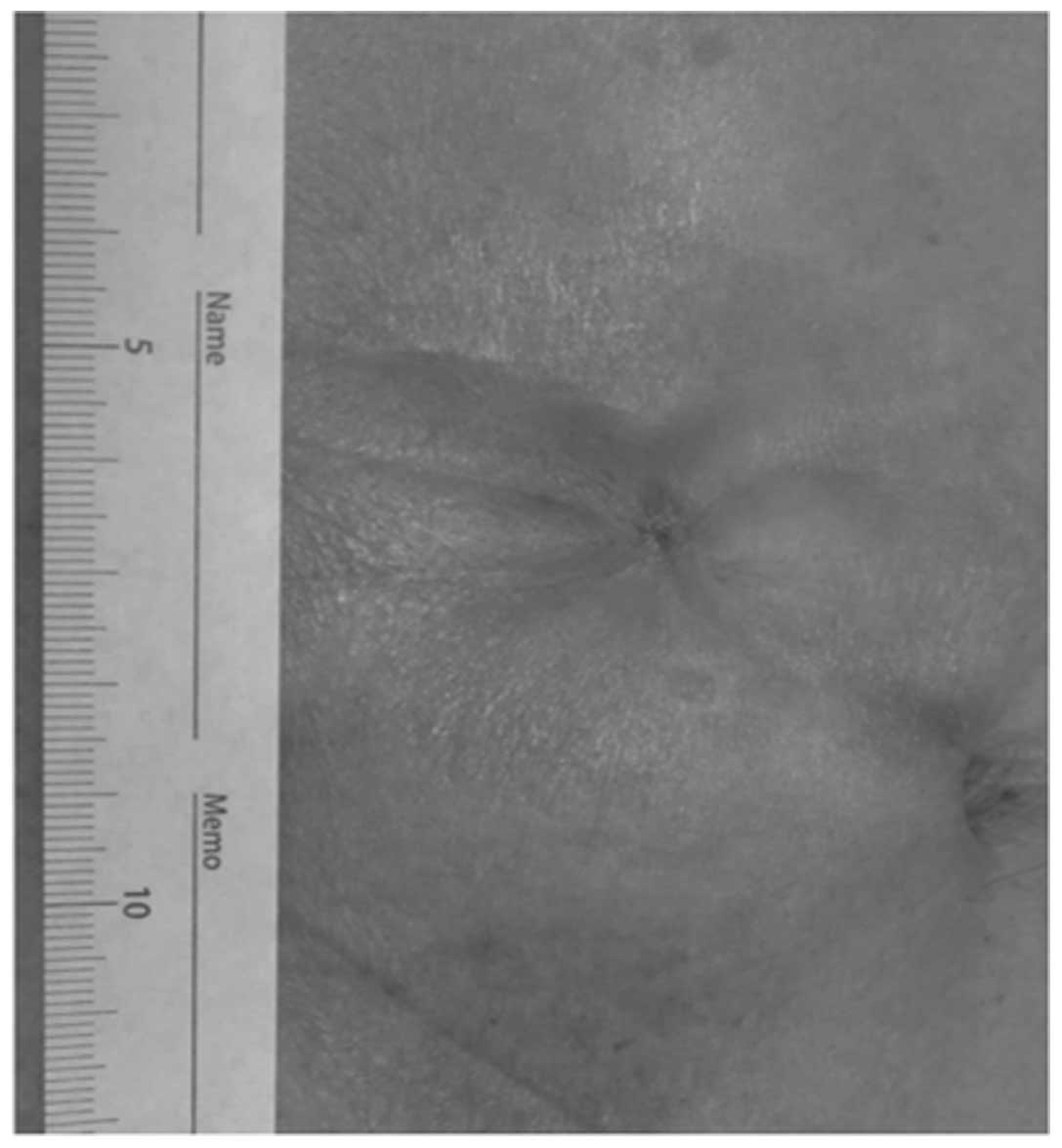
In the present study, the SSI rate in the CD group was 8.3%, which is consistent with previous reports (10,11). However, no patients developed SSI in the PS group. This finding is in accordance with a previous report (12). PS of stoma reversal is a cosmetically superior approach (3). A recent study compared patients treated using PS to those treated using primary closure (12) and found that no SSI occurred in the PS group compared to the CD group, in which 40% of patients developed SSI (P=0.001). These results suggest a lower risk of SSI when PS is used. To effectively prevent SSI, it is important to maintain the drainage hole until the discharge from the wound is reduced (Fig. 2).

Recently, PS has been a focus of investigation with regard to better cosmetic appearance (Fig. 3) (13,14). In the present study, the wound length was evaluated in both groups. PS was performed and ~0.5 cm of the wound was maintained open in order to drain the discharge. By contrast, the patients in the CD group required a ~6-cm linear suture. Taken together, the results suggest that PS allows for better cosmesis in addition to the lower risk of SSI development.

Figure 3.

Postoperative picture 1 month following purse-string skin closure. The scar became smaller, allowing for better cosmesis.

With the improvement of surgical techniques for anal preservation by sLAR and ISR in patients with rectal cancer, the opportunities for primary artificial anus construction have increased. Stoma closure is associated with a high risk of wound infection; therefore, it is important to evaluate the usefulness of PS and open drainage system to prevent severe SSI. We are currently conducting a randomized trial to confirm our findings and assess additional end points, including cost-effectiveness and patient satisfaction.

In conclusion, the present study suggests that PS is associated with a lower risk of postoperative SSI compared to primary skin closure, even with the placement of a drainage tube; it also allows for better cosmesis, including a more favorable wound length, indicating that PS may be a favorable alternative to primary skin closure.

References

1 

Hackam DJ and Rotstein OD: Stoma closure and wound infection: an evaluation of risk factors. Can J Surg. 38:144–148. 1995.PubMed/NCBI

2 

Wong KS, Remzi FH, Gorgun E, et al: Loop ileostomy closure after restorative proctocolectomy: outcome in 1,504 patients. Dis Colon Rectum. 48:243–250. 2005. View Article : Google Scholar : PubMed/NCBI

3 

Banerjee A: Pursestring skin closure after stoma reversal. Dis Colon Rectum. 40:993–994. 1997. View Article : Google Scholar : PubMed/NCBI

4 

Imada S, Noura S, Ohue M, et al: Efficacy of subcutaneous penrose drains for surgical site infections in colorectal surgery. World J Gastrointest Surg. 5:110–114. 2013. View Article : Google Scholar : PubMed/NCBI

5 

Mirbagheri N, Dark J and Skinner S: Factors predicting stomal wound closure infection rates. Tech Coloproctol. 17:215–220. 2013. View Article : Google Scholar : PubMed/NCBI

6 

Chow A, Tilney HS, Paraskeva P, Jeyarajah S, Zacharakis E and Purkayastha S: The morbidity surrounding reversal of defunctioning ileostomies: a systematic review of 48 studies including 6,107 cases. Int J Colorectal Dis. 24:711–723. 2009. View Article : Google Scholar : PubMed/NCBI

7 

Vermulst N, Vermeulen J, Hazebroek EJ, Coene PP and van der Harst E: Primary closure of the skin after stoma closure. Management of wound infections is easy without (long-term) complications. Dig Surg. 23:255–258. 2006. View Article : Google Scholar : PubMed/NCBI

8 

Williams LA, Sagar PM, Finan PJ and Burke D: The outcome of loop ileostomy closure: a prospective study. Colorectal Dis. 10:460–464. 2008. View Article : Google Scholar : PubMed/NCBI

9 

Garcia-Botello SA, Garcia-Armengol J, Garcia-Granero E, et al: A prospective audit of the complications of loop ileostomy construction and takedown. Dig Surg. 21:440–446. 2004. View Article : Google Scholar : PubMed/NCBI

10 

Parks SE and Hastings PR: Complications of colostomy closure. Am J Surg. 149:672–675. 1985. View Article : Google Scholar : PubMed/NCBI

11 

Pittman DM and Smith LE: Complications of colostomy closure. Dis Colon Rectum. 28:836–843. 1985. View Article : Google Scholar : PubMed/NCBI

12 

Milanchi S, Nasseri Y, Kidner T and Fleshner P: Wound infection after ileostomy closure can be eliminated by circumferential subcuticular wound approximation. Dis Colon Rectum. 52:469–474. 2009. View Article : Google Scholar : PubMed/NCBI

13 

Marquez TT, Christoforidis D, Abraham A, Madoff RD and Rothenberger DA: Wound infection following stoma takedown: primary skin closure versus subcuticular purse-string suture. World J Surg. 34:2877–2882. 2010. View Article : Google Scholar : PubMed/NCBI

14 

Lee JR, Kim YW, Sung JJ, et al: Conventional linear versus purse-string skin closure after loop ileostomy reversal: comparison of wound infection rates and operative outcomes. J Korean Soc Coloproctol. 27:58–63. 2011. View Article : Google Scholar : PubMed/NCBI

Related Articles

  • Abstract
  • View
  • Download
  • Twitter
Copy and paste a formatted citation
Spandidos Publications style
Wada Y, Miyoshi N, Ohue M, Noura S, Fujino S, Sugimura K, Akita H, Motoori M, Gotoh K, Takahashi H, Takahashi H, et al: Comparison of surgical techniques for stoma closure: A retrospective study of purse‑string skin closure versus conventional skin closure following ileostomy and colostomy reversal. Mol Clin Oncol 3: 619-622, 2015.
APA
Wada, Y., Miyoshi, N., Ohue, M., Noura, S., Fujino, S., Sugimura, K. ... Yano, M. (2015). Comparison of surgical techniques for stoma closure: A retrospective study of purse‑string skin closure versus conventional skin closure following ileostomy and colostomy reversal. Molecular and Clinical Oncology, 3, 619-622. https://doi.org/10.3892/mco.2015.505
MLA
Wada, Y., Miyoshi, N., Ohue, M., Noura, S., Fujino, S., Sugimura, K., Akita, H., Motoori, M., Gotoh, K., Takahashi, H., Kobayashi, S., Ohmori, T., Fujiwara, Y., Yano, M."Comparison of surgical techniques for stoma closure: A retrospective study of purse‑string skin closure versus conventional skin closure following ileostomy and colostomy reversal". Molecular and Clinical Oncology 3.3 (2015): 619-622.
Chicago
Wada, Y., Miyoshi, N., Ohue, M., Noura, S., Fujino, S., Sugimura, K., Akita, H., Motoori, M., Gotoh, K., Takahashi, H., Kobayashi, S., Ohmori, T., Fujiwara, Y., Yano, M."Comparison of surgical techniques for stoma closure: A retrospective study of purse‑string skin closure versus conventional skin closure following ileostomy and colostomy reversal". Molecular and Clinical Oncology 3, no. 3 (2015): 619-622. https://doi.org/10.3892/mco.2015.505
Copy and paste a formatted citation
x
Spandidos Publications style
Wada Y, Miyoshi N, Ohue M, Noura S, Fujino S, Sugimura K, Akita H, Motoori M, Gotoh K, Takahashi H, Takahashi H, et al: Comparison of surgical techniques for stoma closure: A retrospective study of purse‑string skin closure versus conventional skin closure following ileostomy and colostomy reversal. Mol Clin Oncol 3: 619-622, 2015.
APA
Wada, Y., Miyoshi, N., Ohue, M., Noura, S., Fujino, S., Sugimura, K. ... Yano, M. (2015). Comparison of surgical techniques for stoma closure: A retrospective study of purse‑string skin closure versus conventional skin closure following ileostomy and colostomy reversal. Molecular and Clinical Oncology, 3, 619-622. https://doi.org/10.3892/mco.2015.505
MLA
Wada, Y., Miyoshi, N., Ohue, M., Noura, S., Fujino, S., Sugimura, K., Akita, H., Motoori, M., Gotoh, K., Takahashi, H., Kobayashi, S., Ohmori, T., Fujiwara, Y., Yano, M."Comparison of surgical techniques for stoma closure: A retrospective study of purse‑string skin closure versus conventional skin closure following ileostomy and colostomy reversal". Molecular and Clinical Oncology 3.3 (2015): 619-622.
Chicago
Wada, Y., Miyoshi, N., Ohue, M., Noura, S., Fujino, S., Sugimura, K., Akita, H., Motoori, M., Gotoh, K., Takahashi, H., Kobayashi, S., Ohmori, T., Fujiwara, Y., Yano, M."Comparison of surgical techniques for stoma closure: A retrospective study of purse‑string skin closure versus conventional skin closure following ileostomy and colostomy reversal". Molecular and Clinical Oncology 3, no. 3 (2015): 619-622. https://doi.org/10.3892/mco.2015.505
Follow us
  • Twitter
  • LinkedIn
  • Facebook
About
  • Spandidos Publications
  • Careers
  • Cookie Policy
  • Privacy Policy
How can we help?
  • Help
  • Live Chat
  • Contact
  • Email to our Support Team