Spandidos Publications Logo
  • About
    • About Spandidos
    • Aims and Scopes
    • Abstracting and Indexing
    • Editorial Policies
    • Reprints and Permissions
    • Job Opportunities
    • Terms and Conditions
    • Contact
  • Journals
    • All Journals
    • Oncology Letters
      • Oncology Letters
      • Information for Authors
      • Editorial Policies
      • Editorial Board
      • Aims and Scope
      • Abstracting and Indexing
      • Bibliographic Information
      • Archive
    • International Journal of Oncology
      • International Journal of Oncology
      • Information for Authors
      • Editorial Policies
      • Editorial Board
      • Aims and Scope
      • Abstracting and Indexing
      • Bibliographic Information
      • Archive
    • Molecular and Clinical Oncology
      • Molecular and Clinical Oncology
      • Information for Authors
      • Editorial Policies
      • Editorial Board
      • Aims and Scope
      • Abstracting and Indexing
      • Bibliographic Information
      • Archive
    • Experimental and Therapeutic Medicine
      • Experimental and Therapeutic Medicine
      • Information for Authors
      • Editorial Policies
      • Editorial Board
      • Aims and Scope
      • Abstracting and Indexing
      • Bibliographic Information
      • Archive
    • International Journal of Molecular Medicine
      • International Journal of Molecular Medicine
      • Information for Authors
      • Editorial Policies
      • Editorial Board
      • Aims and Scope
      • Abstracting and Indexing
      • Bibliographic Information
      • Archive
    • Biomedical Reports
      • Biomedical Reports
      • Information for Authors
      • Editorial Policies
      • Editorial Board
      • Aims and Scope
      • Abstracting and Indexing
      • Bibliographic Information
      • Archive
    • Oncology Reports
      • Oncology Reports
      • Information for Authors
      • Editorial Policies
      • Editorial Board
      • Aims and Scope
      • Abstracting and Indexing
      • Bibliographic Information
      • Archive
    • Molecular Medicine Reports
      • Molecular Medicine Reports
      • Information for Authors
      • Editorial Policies
      • Editorial Board
      • Aims and Scope
      • Abstracting and Indexing
      • Bibliographic Information
      • Archive
    • World Academy of Sciences Journal
      • World Academy of Sciences Journal
      • Information for Authors
      • Editorial Policies
      • Editorial Board
      • Aims and Scope
      • Abstracting and Indexing
      • Bibliographic Information
      • Archive
    • International Journal of Functional Nutrition
      • International Journal of Functional Nutrition
      • Information for Authors
      • Editorial Policies
      • Editorial Board
      • Aims and Scope
      • Abstracting and Indexing
      • Bibliographic Information
      • Archive
    • International Journal of Epigenetics
      • International Journal of Epigenetics
      • Information for Authors
      • Editorial Policies
      • Editorial Board
      • Aims and Scope
      • Abstracting and Indexing
      • Bibliographic Information
      • Archive
    • Medicine International
      • Medicine International
      • Information for Authors
      • Editorial Policies
      • Editorial Board
      • Aims and Scope
      • Abstracting and Indexing
      • Bibliographic Information
      • Archive
  • Articles
  • Information
    • Information for Authors
    • Information for Reviewers
    • Information for Librarians
    • Information for Advertisers
    • Conferences
  • Language Editing
Spandidos Publications Logo
  • About
    • About Spandidos
    • Aims and Scopes
    • Abstracting and Indexing
    • Editorial Policies
    • Reprints and Permissions
    • Job Opportunities
    • Terms and Conditions
    • Contact
  • Journals
    • All Journals
    • Biomedical Reports
      • Information for Authors
      • Editorial Policies
      • Editorial Board
      • Aims and Scope
      • Abstracting and Indexing
      • Bibliographic Information
      • Archive
    • Experimental and Therapeutic Medicine
      • Information for Authors
      • Editorial Policies
      • Editorial Board
      • Aims and Scope
      • Abstracting and Indexing
      • Bibliographic Information
      • Archive
    • International Journal of Epigenetics
      • Information for Authors
      • Editorial Policies
      • Editorial Board
      • Aims and Scope
      • Abstracting and Indexing
      • Bibliographic Information
      • Archive
    • International Journal of Functional Nutrition
      • Information for Authors
      • Editorial Policies
      • Editorial Board
      • Aims and Scope
      • Abstracting and Indexing
      • Bibliographic Information
      • Archive
    • International Journal of Molecular Medicine
      • Information for Authors
      • Editorial Policies
      • Editorial Board
      • Aims and Scope
      • Abstracting and Indexing
      • Bibliographic Information
      • Archive
    • International Journal of Oncology
      • Information for Authors
      • Editorial Policies
      • Editorial Board
      • Aims and Scope
      • Abstracting and Indexing
      • Bibliographic Information
      • Archive
    • Medicine International
      • Information for Authors
      • Editorial Policies
      • Editorial Board
      • Aims and Scope
      • Abstracting and Indexing
      • Bibliographic Information
      • Archive
    • Molecular and Clinical Oncology
      • Information for Authors
      • Editorial Policies
      • Editorial Board
      • Aims and Scope
      • Abstracting and Indexing
      • Bibliographic Information
      • Archive
    • Molecular Medicine Reports
      • Information for Authors
      • Editorial Policies
      • Editorial Board
      • Aims and Scope
      • Abstracting and Indexing
      • Bibliographic Information
      • Archive
    • Oncology Letters
      • Information for Authors
      • Editorial Policies
      • Editorial Board
      • Aims and Scope
      • Abstracting and Indexing
      • Bibliographic Information
      • Archive
    • Oncology Reports
      • Information for Authors
      • Editorial Policies
      • Editorial Board
      • Aims and Scope
      • Abstracting and Indexing
      • Bibliographic Information
      • Archive
    • World Academy of Sciences Journal
      • Information for Authors
      • Editorial Policies
      • Editorial Board
      • Aims and Scope
      • Abstracting and Indexing
      • Bibliographic Information
      • Archive
  • Articles
  • Information
    • For Authors
    • For Reviewers
    • For Librarians
    • For Advertisers
    • Conferences
  • Language Editing
Login Register Submit
  • This site uses cookies
  • You can change your cookie settings at any time by following the instructions in our Cookie Policy. To find out more, you may read our Privacy Policy.

    I agree
Search articles by DOI, keyword, author or affiliation
Search
Advanced Search
presentation
Experimental and Therapeutic Medicine
Join Editorial Board Propose a Special Issue
Print ISSN: 1792-0981 Online ISSN: 1792-1015
Journal Cover
October-2015 Volume 10 Issue 4

Full Size Image

Sign up for eToc alerts
Recommend to Library

Journals

International Journal of Molecular Medicine

International Journal of Molecular Medicine

International Journal of Molecular Medicine is an international journal devoted to molecular mechanisms of human disease.

International Journal of Oncology

International Journal of Oncology

International Journal of Oncology is an international journal devoted to oncology research and cancer treatment.

Molecular Medicine Reports

Molecular Medicine Reports

Covers molecular medicine topics such as pharmacology, pathology, genetics, neuroscience, infectious diseases, molecular cardiology, and molecular surgery.

Oncology Reports

Oncology Reports

Oncology Reports is an international journal devoted to fundamental and applied research in Oncology.

Experimental and Therapeutic Medicine

Experimental and Therapeutic Medicine

Experimental and Therapeutic Medicine is an international journal devoted to laboratory and clinical medicine.

Oncology Letters

Oncology Letters

Oncology Letters is an international journal devoted to Experimental and Clinical Oncology.

Biomedical Reports

Biomedical Reports

Explores a wide range of biological and medical fields, including pharmacology, genetics, microbiology, neuroscience, and molecular cardiology.

Molecular and Clinical Oncology

Molecular and Clinical Oncology

International journal addressing all aspects of oncology research, from tumorigenesis and oncogenes to chemotherapy and metastasis.

World Academy of Sciences Journal

World Academy of Sciences Journal

Multidisciplinary open-access journal spanning biochemistry, genetics, neuroscience, environmental health, and synthetic biology.

International Journal of Functional Nutrition

International Journal of Functional Nutrition

Open-access journal combining biochemistry, pharmacology, immunology, and genetics to advance health through functional nutrition.

International Journal of Epigenetics

International Journal of Epigenetics

Publishes open-access research on using epigenetics to advance understanding and treatment of human disease.

Medicine International

Medicine International

An International Open Access Journal Devoted to General Medicine.

Journal Cover
October-2015 Volume 10 Issue 4

Full Size Image

Sign up for eToc alerts
Recommend to Library

  • Article
  • Citations
    • Cite This Article
    • Download Citation
    • Create Citation Alert
    • Remove Citation Alert
    • Cited By
  • Similar Articles
    • Related Articles (in Spandidos Publications)
    • Similar Articles (Google Scholar)
    • Similar Articles (PubMed)
  • Download PDF
  • Download XML
  • View XML
Article

A case of mushroom‑shaped anaplastic oligodendroglioma resembling meningioma and arteriovenous malformation: Inadequacies of diagnostic imaging

  • Authors:
    • Yaoling Liu
    • Kang Yang
    • Xu Sun
    • Xinyu Li
    • Minghai Wei
    • Xiang'en Shi
    • Ningwei Che
    • Jian Yin
  • View Affiliations / Copyright

    Affiliations: Department of Neurosurgery, The Second Affiliated Hospital of Dalian Medical University, Dalian, Liaoning 116044, P.R. China, Department of Neurosurgery, Affiliated Fuxing Hospital, The Capital University of Medical Sciences, Beijing 100038, P.R. China
  • Pages: 1499-1502
    |
    Published online on: August 10, 2015
       https://doi.org/10.3892/etm.2015.2676
  • Expand metrics +
Metrics: Total Views: 0 (Spandidos Publications: | PMC Statistics: )
Metrics: Total PDF Downloads: 0 (Spandidos Publications: | PMC Statistics: )
Cited By (CrossRef): 0 citations Loading Articles...

This article is mentioned in:


Abstract

Magnetic resonance imaging (MRI) is the most widely discussed and clinically employed method for the differential diagnosis of oligodendrogliomas; however, MRI occasionally produces unclear results that can hinder a definitive oligodendroglioma diagnosis. The present study describes the case of a 34‑year‑old man that suffered from headache and right upper‑extremity weakness for 2 months. Based on the presurgical evaluation, it was suggested that the patient had a World Health Organization (WHO) grade II‑II glioma, meningioma or arteriovenous malformation (AVM), with unclear radiological manifestations. Postsurgical pathological assessment confirmed the tumor to be an anaplastic oligodendroglioma (WHO grade Ⅲ). This case is notable due to the confusing radiological manifestation of a mushroom‑shaped anaplastic oligodendroglioma in the parietal‑temporal‑occipital region, which provided a potential source of misdiagnosis for meningioma and AVM.

Introduction

Oligodendroglioma is the third most common type of intracranial glioma and originates from neuroepithelial cells, accounting for 2–5% of primary brain tumors and 4–15% of gliomas (1). The World Health Organization (WHO) classification system separates oligodendrogliomas histopathologically into low-grade (WHO II, 77%) and high-grade or anaplastic (WHO III, 23%) tumor categories. Anaplastic oligoastrocytomas with necrosis are classified as glioblastomas (WHO IV) (2). The median survival times of patients with WHO II and WHO III oligodendrogliomas are 9.8 and 3.9 years, respectively (1,2), and 6.3 and 2.8 years, respectively, if mixed with astrocytes (3,4). Surgical excision and postoperative adjuvant radiotherapy is the traditional therapy for oligodendroglioma; however, studies have observed that, among intracranial tumors, anaplastic oligodendrogliomas are particularly sensitive to chemotherapy, and the prognosis of patients treated with chemotherapy is more favorable than that of patients treated with radiotherapy (5–7). The preoperative differential diagnosis is, therefore, particularly important for therapeutic decisions and determining the prognosis of the patient. Magnetic resonance imaging (MRI) is widely discussed in the literature and employed in clinical practice (6); however, it may produce unclear results that can hinder a definitive diagnosis of oligodendroglioma. The present study describes a case of oligodendroglioma in which the results of the MRI examination were unclear, and pathological analysis was subsequently used to confirm a diagnosis of atypical anaplastic oligodendroglioma.

Case report

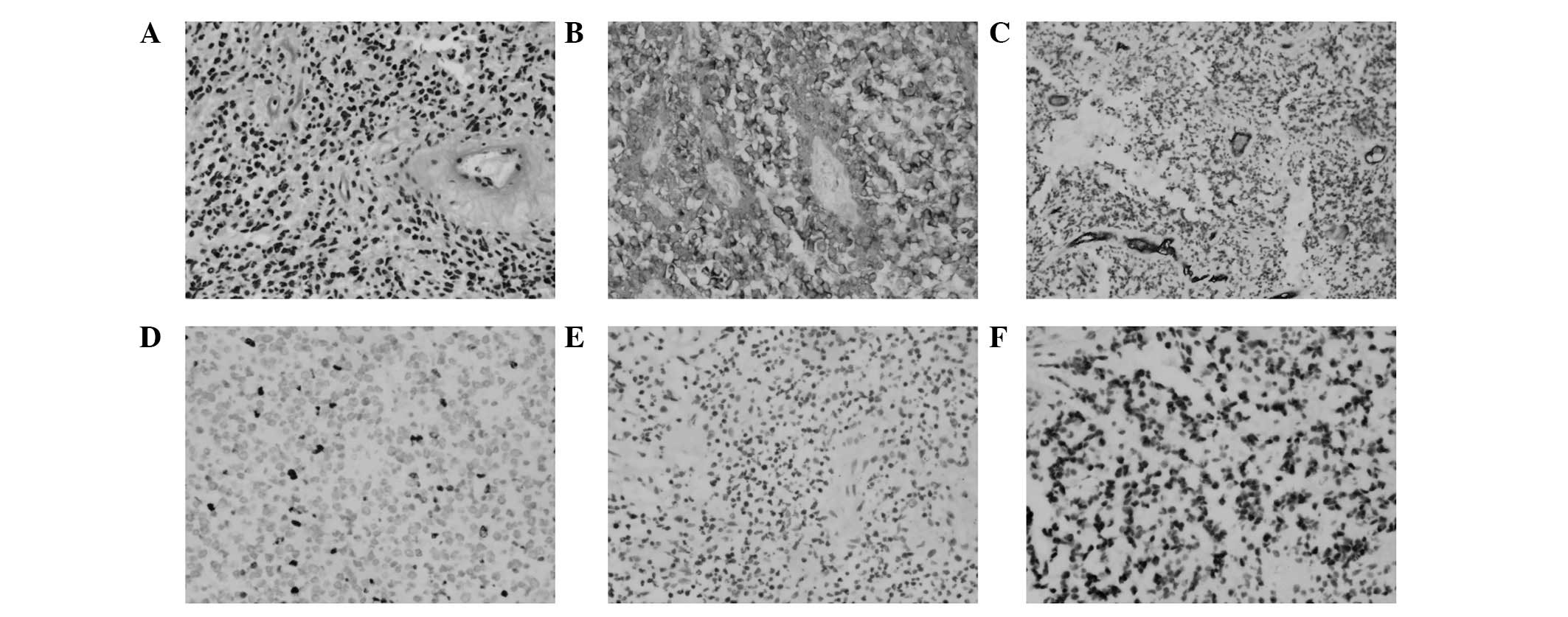
A 34-year-old man who suffered from headache and right upper-extremity weakness for 2 months was referred to The Second Affiliated Hospital of Dalian Medical University (Dalian, China) for medical care. Informed consent was obtained from the patients family. The patient exhibited no impairment of consciousness, hearing, vision or sensory perception. Physical examinations revealed that the patient exhibited decreased hearing in his left ear, upper-extremity numbness and muscle strength decline. Axial computed tomography (CT) examination of the brain showed a large, high-density mass with calcification in the right parietal-temporal-occipital area, and the top of the mass pressed against the parieto-occipital subdural matter (Fig. 1A). An MRI scan revealed a mushroom-shaped mass, which was divided by the Sylvian fissure. The mass exhibited heterogeneous hypointensity under T1-weighted imaging (T1WI) and hyperintensity under T2WI and fluid-attenuated inversion recovery imaging, which was caused by brain parenchyma deformation, with obvious peritumoral edema (Fig. 1B–D). The mass was heterogeneously enhanced following the intravenous administration of gadolinium, with prominent feeding arteries. In addition, the boundary of the tumor was enhanced, which appeared as blurriness under T2WI (Fig. 1E). The frontal view of the internal carotid artery, obtained using digital subtraction angiography (DSA), did not show an obvious mass with large arteriovenous shunts or a vascular nidus resembling a true arteriovenous malformation (AVM); however, the right middle cerebral artery and the draining vein were thickened. Based on the presurgical evaluation, it was suggested that the patient had a WHO grade II or III meningioma or AVM, as the radiological manifestations were unclear. Due to the patient's impaired function and the results of the radiological examination, a surgical resection was performed. During surgery, the partial dura mater was pushed outward by the tumor with high tension. Notably, soft, gray-red, cystic, highly liquid tissue with high-transmittance, with a jelly-like appearance, was expelled instead of adhering to the dura mater when cut radially. As expected, the insidious tumor growth boundaries were clear on the surrounding normal brain, which was covered by slightly yellowish particles on the membrane; however, the results of the pathological examination of the frozen section revealed an anaplastic glioma. The residual tumor, which was gelatinous and pinkish-gray in color, was subsequently separated in order to achieve subtotal excision. The immunostaining results (Fig. 2) were positive for glial fibrillary acidic protein (Fig. 2B); cluster of differentiation (CD) 34, which indicated the presence of blood vessel proliferation (Fig. 2C); and oligo-2, which is closely associated with oligodendrogliomas (Fig. 2F), but negative for NeuN (Fig. 2E). The Ki-67 index was 10%, which indicated a high risk of recurrence (Fig. 2D). Accordingly, the postsurgical assessment confirmed that the mass was an anaplastic oligodendroglioma (WHO III), and the postoperative treatment proceeded with adjuvant radiation and chemotherapy. Radiographic follow-up evaluation after 6 months revealed no indications of tumor recurrence.

Figure 1.

Imaging findings. (A) Axial computed tomography scan of the brain showed a large, high-density mass with calcification in the right parietal-temporal-occipital area; the top of the mass bulged onto the parieto-occipital subdural matter. (B) T1-weighted imaging (T1WI) and (C) T2WI magnetic resonance imaging scans revealed a mushroom-shaped growing mass, which was divided by the Sylvian fissure and appeared hypointense under T1WI and hyperintense under T2WI. (D) Axial T2 fluid-attenuated inversion recovery imaging revealed a hyperintense signal. (E) The mass was heterogeneously enhanced with prominent feeding arteries. (F) Frontal view of the internal carotid on digital subtraction angiography revealed no obvious mass lesion with large arteriovenous shunts or a vascular nidus mimicking a true arteriovenous malformation; however, the right middle cerebral artery and the draining vein were thickened.

Figure 2.

Pathological examination. (A) Hematoxylin and eosin-stained tissue (magnification, x100); (B) glial fibrillary acidic protein-positive tissue (magnification, x100); (C) cluster of differentiation 34-positive tissue, which indicates the proliferation of blood vessels (magnification, x40); (D) Ki-67, index 10% (x100); (E) NeuN-negative tissue (magnification, x100); and (F) oligo-2-positive tissue (magnification, x100).

Discussion

The present case was notable due to the unclear radiological manifestations, which increased the difficulty of presurgical diagnosis. The rare growth pattern and morphology of the oligodendroglioma was also notable.

Oligodendrogliomas typically appear as hypodense (57–70%) or isodense images under CT examination; however, the present case had a tendency towards a hyperdense appearance. It is established that intratumoral calcification is typical for meningioma; however, in cases of oligodendroglioma the incidence has been reported to be 50–90% (8,9). The shape of the calcification can be categorized as coarse, punctate or linear. The uneven edges of the calcified lesion manifest fairly discrete margins under CT imaging (2,8). Thus, in the present case the calcification complicated the differential diagnosis. Additionally, the tumor was closely but non-aggressively associated with the calvaria, and the boundary was relatively clear. It was therefore not possible to differentiate oligodendroglioma from meningioma based upon CT alone.

Under MRI, the most prominent feature of the present tumor was the aforementioned mushroom-shape, which penetrated the cerebral cortex and arachnoid to the subdural space. The region near the posterior horn of the lateral ventricle represented the stalk of the mushroom. The cap of the mushroom-shaped tumor grew along the subdural space and connected with the endocranium to form a wide base resembling a meningioma under MRI. This type of growth pattern resembled two lesions at different sections. The stalk part exhibited invasive growth; conversely, the tumor capsule forming the cap of the mushroom, which was confirmed during surgery, was obvious.

There are numerous forms of tumor enhancement, including nodular and ring. Previous studies have suggested that a number of anaplastic oligodendrogliomas cannot be enhanced; however, a few low-grade (WHO II) tumors have been observed to be enhanced (10,11). The absence of the dural tail sign and uneven enhancement under enhanced MRI suggest that the possibility of meningioma is limited.

Peritumoral edema is considered to be a key indicator of high-grade intracranial tumors; however, oligodendrogliomas are rarely associated with peritumoral vasogenic edema. Peritumoral edema cannot, therefore, be used as an indicator of tumor grading (12). In the present study, peritumoral edema was evident, but the pattern of edema was distinct from the finger-like pattern of edema associated with gliomas; therefore the evidence for a glioma was also insufficient.

Oligodendrogliomas are closely associated with AVMs, both in terms of histopathology and radiology (13). In a previous study, a patient was diagnosed with AVM and received embolization, yet developed a glioma 10 years later at the same site. Certain lesions appear to be oligodendrogliomas rich in vessels during preoperative diagnosis, but are subsequently pathologically confirmed as AVM through immunohistochemistry (14,15). Vascular endothelial growth factor (VEGF) receptor, Ki-67 and CD34 have been associated with abnormal tumor angiogenesis, and the overexpression of VEGF, angiogenesis (contrast enhancement or endothelial hyperplasia) and absence of seizures are considered high-risk factors for poor prognosis (13). In the present study, the thick vascular enhancement on MRI was verified as a vein using DSA; this vein was before the normal venous drainage on the hemisphere surface from the sagittal view. Furthermore, the diameter was ~2-fold that of the normal venous drainage (Fig. 1D and F). Therefore, it may be useful to conduct DSA for cases in which MRI is unable to differentiate between oligodendroglioma and AVM.

In conclusion, the present study has described a type of mushroom-shaped anaplastic oligodendroglioma in the parietal-temporal-occipital region. This mushroom-shaped anaplastic oligodendroglioma, albeit extremely rare, is a potential source of misdiagnosis for meningioma and AVM.

Acknowledgements

The authors thank Mr. Hang Yin for his assistance in the collection of materials.

References

1 

Engelhard HH, Stelea A and Mundt A: Oligodendroglioma and anaplastic oligodendroglioma: Clinical features, treatment, and prognosis. Surg Neurol. 60:443–456. 2003. View Article : Google Scholar : PubMed/NCBI

2 

Louis DN, Ohgaki H, Wiestler OD, Cavenee WK, Burger PC, Jouvet A, Scheithauer BW and Kleihues P: The 2007 WHO classification of tumours of the central nervous system. Acta Neuropathol. 114:97–109. 2007. View Article : Google Scholar : PubMed/NCBI

3 

HoangXuan K, Capelle L, Kujas M, Taillibert S, Duffau H, Lejeune J, Polivka M, Crinière E, Marie Y, Mokhtari K, et al: Temozolomide as initial treatment for adults with low-grade oligodendrogliomas or oligoastrocytomas and correlation with chromosome 1p deletions. J Clin Oncol. 22:3133–3138. 2004. View Article : Google Scholar : PubMed/NCBI

4 

Shaw EG, Scheithauer BW, O'Fallon JR and Davis DH: Mixed oligoastrocytomas: A survival and prognostic factor analysis. Neurosurgery. 34:577–582. 1994. View Article : Google Scholar : PubMed/NCBI

5 

Perry JR: Oligodendrogliomas: Clinical and genetic correlations. Curr Opin Neurol. 14:705–710. 2001. View Article : Google Scholar : PubMed/NCBI

6 

Jenkinson MD, du Plessis DG, Smith TS, Joyce KA, Warnke PC and Walker C: Histological growth patterns and genotype in oligodendroglial tumours: Correlation with MRI features. Brain. 129:1884–1891. 2006. View Article : Google Scholar : PubMed/NCBI

7 

Mason WP and Cairncross JG: Invited article: The expanding impact of molecular biology on the diagnosis and treatment of gliomas. Neurology. 71:365–373. 2008. View Article : Google Scholar : PubMed/NCBI

8 

Lee YY and Van Tassel P: Intracranial oligodendrogliomas: Imaging findings in 35 untreated cases. AJR Am J Roentgenol. 152:361–369. 1989. View Article : Google Scholar : PubMed/NCBI

9 

Dolinskas CA and Simeone FA: CT characteristics of intraventricular oligodendrogliomas. AJNR Am J Neuroradiol. 8:1077–1082. 1987.PubMed/NCBI

10 

Ginsberg LE, Fuller GN, Hashmi M, Leeds NE and Schomer DF: The significance of lack of MR contrast enhancement of supratentorial brain tumors in adults: Histopathological evaluation of a series. Surg Neurol. 49:436–440. 1998. View Article : Google Scholar : PubMed/NCBI

11 

White ML, Zhang Y, Kirby P and Ryken TC: Can tumor contrast enhancement be used as a criterion for differentiating tumor grades of oligodendrogliomas? AJNR Am J Neuroradiol. 26:784–790. 2005.PubMed/NCBI

12 

Spampinato MV, Smith JK, Kwock L, Ewend M, Grimme JD, Camacho DL and Castillo M: Cerebral blood volume measurements and proton MR spectroscopy in grading of oligodendroglial tumors. AJR Am J Roentgenol. 188:204–212. 2007. View Article : Google Scholar : PubMed/NCBI

13 

Quon H, Hasbini A, Cougnard J, Djafari L, Lacroix C and Abdulkarim B: Assessment of tumor angiogenesis as a prognostic factor of survival in patients with oligodendroglioma. J Neurooncol. 96:277–285. 2010. View Article : Google Scholar : PubMed/NCBI

14 

McKinney JS, Steineke T, Nochlin D and Brisman JL: De novo formation of large arteriovenous shunting and a vascular nidus mimicking an arteriovenous malformation within an anaplastic oligodendroglioma: Treatment with embolization and resection. J Neurosurg. 109:1098–1102. 2008. View Article : Google Scholar : PubMed/NCBI

15 

Gmeiner M, Sonnberger M, Wurm G and Weis S: Glioblastoma with the appearance of arteriovenous malformation: Pitfalls in diagnosis. Clin Neurol Neurosurg. 115:501–506. 2013. View Article : Google Scholar : PubMed/NCBI

Related Articles

  • Abstract
  • View
  • Download
  • Twitter
Copy and paste a formatted citation
Spandidos Publications style
Liu Y, Yang K, Sun X, Li X, Wei M, Shi X, Che N and Yin J: A case of mushroom‑shaped anaplastic oligodendroglioma resembling meningioma and arteriovenous malformation: Inadequacies of diagnostic imaging. Exp Ther Med 10: 1499-1502, 2015.
APA
Liu, Y., Yang, K., Sun, X., Li, X., Wei, M., Shi, X. ... Yin, J. (2015). A case of mushroom‑shaped anaplastic oligodendroglioma resembling meningioma and arteriovenous malformation: Inadequacies of diagnostic imaging. Experimental and Therapeutic Medicine, 10, 1499-1502. https://doi.org/10.3892/etm.2015.2676
MLA
Liu, Y., Yang, K., Sun, X., Li, X., Wei, M., Shi, X., Che, N., Yin, J."A case of mushroom‑shaped anaplastic oligodendroglioma resembling meningioma and arteriovenous malformation: Inadequacies of diagnostic imaging". Experimental and Therapeutic Medicine 10.4 (2015): 1499-1502.
Chicago
Liu, Y., Yang, K., Sun, X., Li, X., Wei, M., Shi, X., Che, N., Yin, J."A case of mushroom‑shaped anaplastic oligodendroglioma resembling meningioma and arteriovenous malformation: Inadequacies of diagnostic imaging". Experimental and Therapeutic Medicine 10, no. 4 (2015): 1499-1502. https://doi.org/10.3892/etm.2015.2676
Copy and paste a formatted citation
x
Spandidos Publications style
Liu Y, Yang K, Sun X, Li X, Wei M, Shi X, Che N and Yin J: A case of mushroom‑shaped anaplastic oligodendroglioma resembling meningioma and arteriovenous malformation: Inadequacies of diagnostic imaging. Exp Ther Med 10: 1499-1502, 2015.
APA
Liu, Y., Yang, K., Sun, X., Li, X., Wei, M., Shi, X. ... Yin, J. (2015). A case of mushroom‑shaped anaplastic oligodendroglioma resembling meningioma and arteriovenous malformation: Inadequacies of diagnostic imaging. Experimental and Therapeutic Medicine, 10, 1499-1502. https://doi.org/10.3892/etm.2015.2676
MLA
Liu, Y., Yang, K., Sun, X., Li, X., Wei, M., Shi, X., Che, N., Yin, J."A case of mushroom‑shaped anaplastic oligodendroglioma resembling meningioma and arteriovenous malformation: Inadequacies of diagnostic imaging". Experimental and Therapeutic Medicine 10.4 (2015): 1499-1502.
Chicago
Liu, Y., Yang, K., Sun, X., Li, X., Wei, M., Shi, X., Che, N., Yin, J."A case of mushroom‑shaped anaplastic oligodendroglioma resembling meningioma and arteriovenous malformation: Inadequacies of diagnostic imaging". Experimental and Therapeutic Medicine 10, no. 4 (2015): 1499-1502. https://doi.org/10.3892/etm.2015.2676
Follow us
  • Twitter
  • LinkedIn
  • Facebook
About
  • Spandidos Publications
  • Careers
  • Cookie Policy
  • Privacy Policy
How can we help?
  • Help
  • Live Chat
  • Contact
  • Email to our Support Team